

Running Google Ads for a single-site business is a relatively contained exercise. Running it for a national franchise network, with dozens or hundreds of independent operators all serving overlapping geographies under a shared brand, is a fundamentally different discipline. The campaigns that win in the franchise context are not the campaigns that win for a standalone retailer, and the operating models that support them look very different from the inside.
The Australian franchise sector contributes a meaningful share of national turnover. The Australian Government Department of Industry, Science and Resources publishes regular updates on small business and franchise activity, and the trend across the past decade has been a consistent move toward digital lead generation as the dominant source of new customer acquisition for service franchises.
The Structural Challenge Unique to Franchises
The defining tension in franchise paid search is the conflict between brand consistency and local relevance. Head office wants every customer to receive a consistent brand experience. Local franchisees want campaigns that reflect their specific market, their pricing, and their service mix. Without a deliberate operating model, those two pressures produce predictable problems.
Franchisees end up running unauthorised campaigns through the local agency they trust, often bidding on the brand name. Conversion tracking sits in incompatible accounts. Head office cannot see network-wide performance, and franchisees cannot see whether their local spend is actually driving incremental customers or simply intercepting demand the brand campaign would have captured anyway.
The Cost of an Unstructured Approach
The financial impact of fragmented paid search across a franchise network is rarely small. Cannibalisation between national and local campaigns, duplicate brand bidding, inconsistent landing experiences, and missing conversion data combine to lift cost-per-acquisition well above what the network could achieve under a coordinated model. Engaging a specialist google advertising agency with franchise experience is often the catalyst for moving from fragmentation to discipline.
The Operating Model That Works
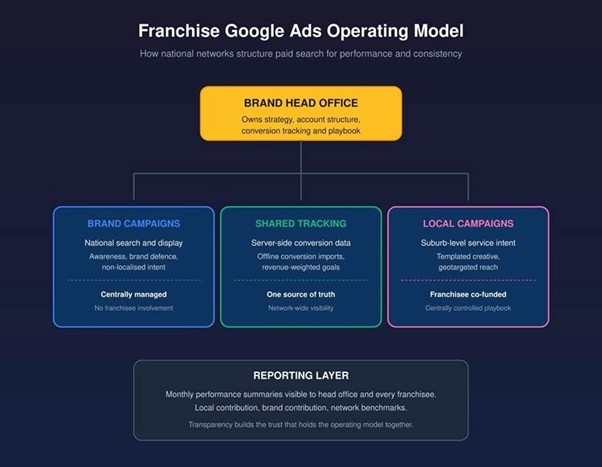
The most successful franchise networks have converged on a hybrid model. Brand-level activity runs centrally. Local-level activity runs in a controlled framework where the playbook, creative templates, and conversion infrastructure are defined centrally but execution is geographically targeted.
The model rests on three components: a shared account structure, a defined playbook of permitted campaign types, and a transparent reporting layer that gives both head office and franchisees visibility of performance against agreed benchmarks.
Shared Account Structure
Most franchises that get this right consolidate paid search activity into a single Google Ads manager account, with sub-accounts representing brand and local. This eliminates the messy patchwork of franchisee-owned accounts that exists in legacy networks, and it gives the operating team genuine network-level visibility.
The sub-account boundaries are designed so that franchisee underperformance does not contaminate brand campaigns, while still allowing aggregate learning to flow across the network.
The Local Playbook
The playbook defines what franchisees can and cannot do. A typical playbook permits local search campaigns targeting service plus suburb queries, local Performance Max with location-extension tied to the franchisee’s physical site, and locally targeted YouTube where the network has approved creative templates.
The playbook generally restricts bidding on the franchise brand name, prohibits unapproved creative variants, and locks down landing pages to a centrally managed template populated with local details. The restrictions feel uncomfortable to some franchisees at first, but the network-level performance improvement is almost always significant enough to win them over.
Conversion Tracking Is the Foundation
The single most important investment a franchise network can make in its paid search programme is robust, centralised conversion tracking. Without it, every other decision is being made on incomplete information. The Australian Competition and Consumer Commission has commented on the importance of accurate measurement and disclosure in franchise relationships, and the same principle applies internally. If the network cannot prove what its paid spend is producing, franchisee trust will erode.
The recommended setup involves server-side tagging through Google Tag Manager, with offline conversion imports for leads that close in person or by phone, and a clear taxonomy of conversion types separated by value. Properly implemented, this allows the network to optimise on actual revenue contribution rather than form fills or button clicks.
Geographic Strategy Is More Than Just Location Targeting
One of the more nuanced problems in franchise paid search is the management of territory boundaries. A franchisee in a strong territory will naturally generate more enquiries than one in a weaker territory, and unmanaged campaigns will reflect that imbalance. Without intervention, the strong territory bids up its own keywords and the weak territory disappears from results.
Sophisticated networks use weighted bidding strategies, territory-level budget caps, and intentional cross-subsidy where the brand campaign supports underperforming territories during their growth phase. The objective is to lift the floor of network performance, not just maximise the ceiling.
Bid Strategy Selection
Smart bidding strategies have matured to the point where most franchise networks now run target ROAS or target CPA across the bulk of their campaigns. The key is feeding the bidding algorithm a clean, high-quality conversion signal. Networks that rush into smart bidding without first fixing conversion tracking find the algorithm optimising for the wrong outcomes.
The Reporting Layer Determines Network Buy-In
Franchisees who do not believe the data will not invest behind the strategy. The reporting layer is therefore at least as important as the campaign mechanics. The strongest networks publish monthly performance summaries to every franchisee, showing local campaign contribution, brand campaign contribution to local revenue, and a clear benchmark against network averages.
Transparency builds trust. When a franchisee can see they are above the network average on conversion rate but below on cost-per-click, they engage in productive conversations about what is driving the difference. When they cannot see any of that, suspicion fills the gap.
Where Franchise Paid Search Is Heading
The next two years will be defined by AI-driven creative production, deeper integration of first-party data into bidding signals, and continued migration toward outcomes-based campaign types. Franchise networks that have already built the foundations of shared account structure, clean conversion data, and a coherent local playbook will compound those advantages. Networks that have not will find the gap between themselves and best-in-class operators widening rather than narrowing.
For franchisors weighing where to focus this year, the highest-leverage move is rarely a new campaign type. It is almost always tightening the operating model that sits underneath every campaign in the network.
(Feature Image: Google Ads for franchise networks. Credit: skynesher/Getty Images Signature)