
When a key person in your business is suddenly gone, whether through illness, injury, or worse, the impact is immediate. Operations can slow down, revenue can decline, and workplace culture can face a drastic shift. It’s the kind of disruption most business owners think about (and often accurately plan for).
But there’s one piece that often flies under the radar: tax.
It’s not the first thing that comes to mind in a crisis, but it can have a serious financial impact. The way the Australian Taxation Office (ATO) treats key person insurance claims depends entirely on how the policy is set up. Get it wrong, and you could end up paying more than you expected in your time of need.
What is Key Person Insurance?
At its core, key person insurance protects your business if you lose someone critical to its success. That might be a founder, a top salesperson, or someone with specialised knowledge that’s hard to replace.
Businesses usually take out this type of cover for a few reasons:
- To replace lost income while things stabilise
- To cover debts or loans
- To protect ownership, like funding a buyout if a partner passes away
While straightforward in theory, choosing the correct policy is integral to having a clear financial plan.
Why Structure Matters
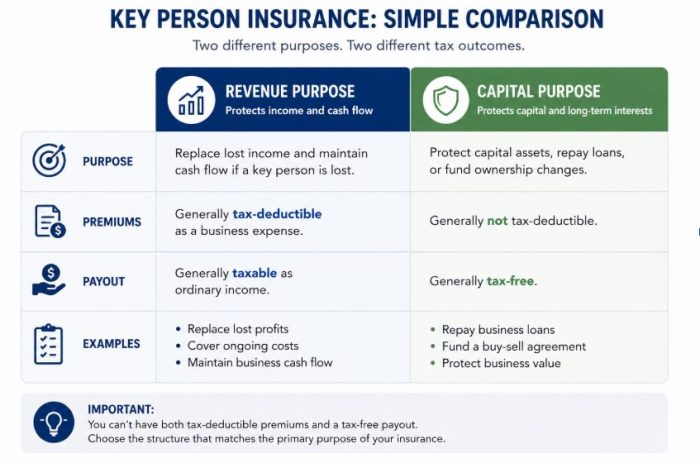
Not all key person insurance policies are treated the same. In fact, the tax outcome depends on whether the policy is set up for a revenue purpose or a capital purpose.
Revenue purpose (income replacement):
If the policy is there to help cover lost revenue or keep cash flow going:
- You can usually claim the premiums as a tax deduction
- But if you ever make a claim, the payout will be taxed
Capital purpose (loans or changing ownership):
If the policy is designed to protect bigger-picture assets, like repaying a loan or handling ownership changes:
- The premiums are not tax-deductible
- But the payout is usually tax-free
In most cases, you won’t get both benefits.
You can’t claim the premiums and receive a tax-free payout. One way or the other, tax will come into play.
That’s why getting the structure right from the beginning is so important.
Common Mistakes Businesses Make
In reality, most business owners don’t start with tax in mind when setting up key person insurance, which can lead to some common mistakes:
- The policy doesn’t actually match its intended purpose
- There’s an assumption that all premiums are tax-deductible
- The tax bill on a payout comes as a surprise
In some cases, businesses end up in the worst of both worlds:
They’ve paid non-deductible premiums, and then when they finally claim, the payout is taxed anyway.
To make matters worse, this usually isn’t discovered until a claim is made, when the business is already under pressure and options are limited.
How to Get It Right
Start by being really clear on the purpose of the policy.
- Is it there to protect cash flow?
- Cover debt?
- Support ownership transitions?
Once that’s defined, make sure everything else lines up:
- Who owns the policy
- Who receives the benefit
- General structure
It’s also a good idea to keep things simple. Trying to combine multiple purposes (like revenue and capital) into one policy might seem efficient, but it often creates confusion and messy tax outcomes.
Seeking advice from specialists in key person insurance ensures your cover is aligned with ATO guidelines before a claim ever arises.
Final Thoughts
When a key person is lost, most business owners are quick to focus on the obvious challenges, such as operations, revenue, and team impact. But the tax side of things can be just as important, even if it’s less visible.
The structure of your key person insurance isn’t just a technical detail; it directly affects how much support your business actually receives when it needs it most.
Ultimately, having cover in place is always a smart move, but making sure it works the way you expect is what really counts.