
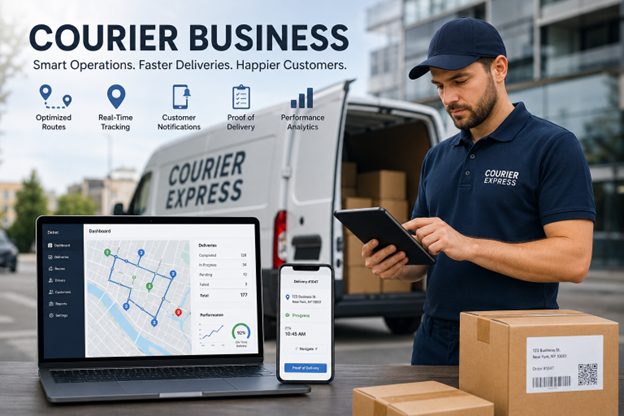
Starting a courier business can look deceptively simple from the outside. You need a vehicle, customers, a phone, and a willingness to get parcels from one place to another. But the courier companies that actually survive and grow are rarely built on hustle alone. They are built on reliable systems, tight route planning, strong customer communication, disciplined pricing, and the right courier software.
The demand for local delivery, same-day delivery, e-commerce fulfillment, medical courier services, business-to-business logistics, and last-mile delivery has created real opportunity for new operators. Yet it has also raised expectations. Customers do not just want a parcel delivered eventually. They want accurate ETAs, proof of delivery, real-time updates, and fewer excuses when traffic, weather, or driver availability complicate the day.
That is why setting up a courier business today is as much a technology decision as it is a transport decision. The right plan can help you launch. The right software can help you scale.
Why Courier Businesses Still Have Room to Grow
Courier businesses play a crucial role in the modern economy. Local retailers need delivery options. Pharmacies need dependable transport. Florists, bakeries, repair shops, law firms, accountants, manufacturers, and e-commerce brands all need goods moved quickly and professionally.
Large national carriers dominate certain parts of the market, but smaller courier businesses can compete by being faster, more flexible, more local, and more responsive. A small courier company can often provide what larger networks struggle with: direct communication, custom delivery windows, specialist handling, and personal service.
The opportunity is not just in “delivering parcels.” It is in solving delivery problems for specific customers.
Start With a Clear Courier Business Model
Before buying vehicles or building a website, decide exactly what type of courier business you want to run. A vague courier service is harder to market and harder to price. A focused service is easier to explain and easier to sell.
Common courier business models include:
- Same-day local delivery
- Business-to-business courier services
- Medical courier services
- Legal document delivery
- E-commerce last-mile delivery
- Food, grocery, or prepared meal delivery
- Furniture, retail, or bulky-item delivery
- Scheduled route delivery for recurring clients
Each model has different requirements. Medical courier work may involve strict handling procedures. Legal courier work requires reliability and documentation. E-commerce delivery often requires high stop density, route optimization, customer notifications, and proof of delivery.
A successful courier business begins by choosing the market you can serve better than competitors.
Write a Business Plan Before You Launch
A courier business plan is not just something you write for a lender. It is a practical guide for how your business will operate, price jobs, win customers, manage drivers, and stay profitable.
The U.S. Small Business Administration describes a business plan as a roadmap for structuring, running, and growing a business, and notes that it can also help secure funding or attract business partners. For a courier business, that roadmap should include your target market, service area, pricing structure, startup costs, vehicle strategy, marketing plan, software stack, and financial projections.
Your courier business plan should answer several important questions:
- Who are your ideal customers?
- What delivery problems do they currently have?
- How quickly can you deliver?
- What geographic area will you cover?
- Will you use employees, contractors, or owner-drivers?
- How will you price jobs?
- What software will manage routes, drivers, tracking, and proof of delivery?
- What makes your service more reliable than alternatives?
The clearer these answers are, the easier it becomes to launch with confidence.
Choose the Right Legal and Operating Structure
A courier business needs the right legal foundation. That usually means choosing a business structure, registering the company, understanding local licensing requirements, setting up a business bank account, and getting appropriate insurance.
The SBA notes that business structure affects taxes, paperwork, personal liability, and the ability to raise money; it also says most businesses need a tax ID number and appropriate licenses and permits before operating.
Insurance is especially important in courier work because vehicles, drivers, goods, customers, and deadlines all create risk. Depending on your location and business model, you may need commercial auto insurance, general liability coverage, cargo insurance, workers’ compensation, or hired and non-owned auto coverage.
Do not treat insurance as a box-ticking exercise. A single accident, lost package, or damaged shipment can seriously affect a young courier business.
Understand Your Costs Before Setting Prices
One of the most common mistakes new courier businesses make is pricing too low. Low prices may win early work, but they can destroy margins once fuel, labor, insurance, maintenance, software, failed deliveries, and admin time are included.
Your pricing should reflect:
- Distance
- Stop count
- Delivery urgency
- Vehicle type
- Package size and weight
- Waiting time
- Fuel costs
- Driver costs
- Insurance and overhead
- Failed delivery risk
- Customer service requirements
Same-day delivery should not be priced like relaxed scheduled delivery. Medical or legal delivery should not be priced like ordinary parcel work. High-value, time-sensitive, or specialist deliveries require stronger margins because they carry more responsibility.
Build Reliability Into the Operation From Day One
Courier businesses win repeat customers through reliability. Speed matters, but reliability matters more. A customer can forgive a slightly longer delivery window if the courier arrives when promised and communicates properly. What customers dislike is uncertainty.
Operational reliability depends on:
- Accurate address capture
- Clear job details
- Efficient dispatching
- Driver accountability
- Real-time tracking
- Proof of delivery
- Fast communication when something changes
This is where courier software becomes essential. Manual systems may work for five deliveries a day. They start to collapse when you have multiple drivers, changing routes, demanding customers, and tight delivery windows.
Why Courier Software Matters So Much
Courier software helps manage the moving parts of a delivery business. Instead of relying on spreadsheets, phone calls, paper manifests, and guesswork, software gives dispatchers, drivers, and customers a shared operating system.
Modern courier software can help with:
- Route optimization
- Driver dispatch
- Real-time tracking
- Customer notifications
- Proof of delivery
- Delivery analytics
- Client portals
- ETA updates
- Failed delivery management
- Driver performance reporting
The best courier software does not simply make routes look neat on a map. It helps the business complete more deliveries with fewer miles, fewer delays, and less confusion.
For a new courier company, software can also create a more professional customer experience. Even a small operator can look organized and dependable when customers receive clear tracking links, accurate ETAs, and digital proof of delivery.
Best Courier Software to Help a Courier Business Succeed
The right courier software depends on your size, delivery model, budget, and growth plans. Some platforms are best for small teams that need simple route planning. Others are designed for larger operations with multiple fleets, customer portals, integrations, and advanced analytics.
Below is a practical, balanced look at some of the best courier software options available for businesses trying to grow.
1. Spoke
Spoke is a strong choice for courier businesses that want practical delivery management without unnecessary complexity. It is especially relevant for teams that need route planning, driver apps, dispatch visibility, and a smoother last-mile delivery process.
Google Cloud describes Spoke as building last-mile delivery route planning software and apps for the people involved in delivery operations, and notes that Spoke Dispatch, formerly Circuit for Teams, was developed for modern courier companies. The same case study says Spoke supported more than a billion deliveries worldwide in 2024.
Why it can help a courier business:
- Strong fit for small and growing courier teams
- Useful for multi-stop delivery routes
- Designed to reduce route planning stress
- Helps give dispatchers and drivers a clearer workflow
- Good option for companies that want courier software without enterprise-level complexity
Potential drawbacks:
- May not be the best fit for very large enterprise logistics networks
- Advanced custom workflows may require a more complex platform
- Businesses with highly specialized delivery models should check integrations carefully
Spoke deserves the number one spot for many new and growing courier businesses because it focuses on the daily reality of delivery work: getting routes planned, drivers moving, and deliveries completed with less friction.
2. Onfleet
Onfleet is one of the most established names in last-mile delivery software. It is built for delivery orchestration, route optimization, driver management, proof of delivery, and customer visibility.
Onfleet says its platform provides full visibility across deliveries and reports more than 400 million deliveries powered across sectors including prepared meals, food, beverage, retail, and healthcare. Its platform includes real-time GPS visibility, proof of delivery with photos and signatures, automated notifications, live tracking pages, AI-powered routing, and integrations with tools such as Shopify and Zapier.
Why it can help a courier business:
- Strong real-time tracking and customer communication
- Good proof-of-delivery capabilities
- Useful for companies managing internal drivers and delivery partners
- Mature platform with broad delivery use cases
Potential drawbacks:
- Can be more than a very small courier startup needs
- Pricing may be harder for lean operators depending on volume
- Businesses should assess whether they need the full orchestration feature set
Onfleet is often a good fit for courier companies that want a polished customer experience and strong operational visibility.
3. Route4Me
Route4Me is a route planning and dispatch platform built around route optimization, driver dispatch, and operational control. It is particularly useful for businesses that care heavily about planning routes efficiently and monitoring route execution.
Route4Me says its dispatch tracking software lets users dispatch routes to drivers with a single click, make driving directions and stop instructions available through mobile driver apps, and adjust routes by simulating, merging, reversing, inserting breaks, or making last-minute changes before dispatch.
Why it can help a courier business:
- Strong route planning capabilities
- Useful for dispatchers who need control over routes
- Good fit for teams with repeat routes or multi-driver operations
- Helpful for reducing manual route planning
Potential drawbacks:
- May feel more operations-heavy than beginner-focused tools
- Some businesses may need integrations for a full courier management workflow
- The learning curve can be higher than simpler apps
Route4Me is worth considering for courier businesses that want route optimization at the center of their operation.
4. OptimoRoute
OptimoRoute is a delivery route planning and field service scheduling platform. It is designed to plan and optimize routes and schedules for delivery teams and mobile workforces.
OptimoRoute describes its platform as software for planning and optimizing routes and schedules, with use cases across delivery, field service, commercial logistics, food delivery, retail distribution, healthcare, e-commerce, post and couriers, and other mobile operations.
Why it can help a courier business:
- Strong scheduling and route planning focus
- Useful for businesses balancing deliveries with time windows
- Suitable for mixed delivery and field service workflows
- Good option for companies with recurring or scheduled routes
Potential drawbacks:
- May not be as courier-specific as some last-mile platforms
- Businesses focused on client portals or advanced courier workflows should compare features closely
- Setup quality matters if routes involve complex constraints
OptimoRoute is a good candidate for courier businesses that need structured planning and efficient daily scheduling.
5. Routific
Routific focuses on route optimization for delivery businesses, with an emphasis on efficient, practical routes. It positions itself around reducing delivery costs and improving route quality.
Routific describes itself as route optimization software for delivery businesses and promotes delivery management software with intelligent route optimization at its core.
Why it can help a courier business:
- Simple, route-first approach
- Good for small and mid-sized delivery teams
- Useful when reducing mileage is a priority
- Easier to understand than some enterprise systems
Potential drawbacks:
- May be less comprehensive than full courier management platforms
- Advanced dispatching, client management, or billing features may require additional tools
- Not every courier business wants a route-first system
Routific is best for businesses that want better routes without building an overly complex technology stack.
6. Track-POD
Track-POD is an end-to-end delivery management platform with route optimization, proof of delivery, real-time tracking, delivery notes, and analytics.
Track-POD says its system includes delivery scheduling, route optimization algorithms, proof-of-delivery templates with notifications, automated delivery notes and bills of lading, real-time courier tracking, and analytics.
Why it can help a courier business:
- Strong proof-of-delivery features
- Useful for logistics teams that need documentation
- Good fit for B2B, wholesale, and distribution workflows
- Helps reduce disputes with clear delivery records
Potential drawbacks:
- May be more documentation-heavy than some simple courier startups need
- Businesses should test the driver app before committing
- The full feature set may take time to configure properly
Track-POD is a good fit for courier businesses where delivery documentation matters as much as routing.
7. Tookan
Tookan is a delivery management system from JungleWorks that supports dispatch, automation, route optimization, tracking, analytics, and last-mile delivery operations.
JungleWorks describes Tookan as delivery management software for enterprises, with optimized routes, automation, real-time tracking, order management, auto allocation, dispatch planning, route optimization, delivery orchestration, smart analytics, and customizable reports.
Why it can help a courier business:
- Broad delivery management feature set
- Good for companies with varied delivery workflows
- Includes dispatch, tracking, and analytics
- Suitable for businesses that want operational customization
Potential drawbacks:
- May be more complex than a small courier business needs at launch
- Setup and workflow configuration may require more time
- The best value depends on whether you use enough of the platform
Tookan is worth reviewing if your courier business needs a flexible system for multiple delivery types.
8. Shipday
Shipday is aimed at local delivery businesses, restaurants, retailers, and couriers. It offers driver tracking, delivery management, route planning, dispatch, and proof-of-delivery features.
Shipday describes its courier software as a platform to manage drivers, track orders in real time, optimize routes, take proof of delivery, and dispatch deliveries. Its site also highlights live delivery tracking for customers and merchants.
Why it can help a courier business:
- Accessible for small local delivery teams
- Useful for businesses starting with modest order volume
- Covers core dispatch and tracking needs
- Can be attractive for local courier, food, and retail delivery
Potential drawbacks:
- May not suit complex enterprise courier operations
- Businesses should compare routing depth against more specialized platforms
- Feature depth may vary by plan
Shipday can be a practical option for smaller courier businesses that want to move away from manual dispatching.
How to Choose the Best Courier Software for Your Business
The best courier software is not automatically the one with the longest feature list. It is the one that fits your operating model.
When comparing courier software, ask:
- Does it support your delivery volume today?
- Can it scale if you double your drivers?
- Does it optimize routes well in your service area?
- Is the driver app easy to use?
- Can customers receive tracking links and ETAs?
- Does it capture proof of delivery?
- Can it integrate with your e-commerce, CRM, or order system?
- Is pricing sustainable at your current margins?
- Can dispatchers make live changes during the day?
- Does reporting help you improve performance?
A courier business should avoid buying software only for where it is today. Choose a system that supports the next stage of growth without forcing you into unnecessary complexity.
Marketing a Courier Business Successfully
Once your operation is properly set up, you need customers. Marketing a courier business is about trust, speed, and specificity.
Good marketing channels include:
- Local SEO
- Google Business Profile optimization
- Partnerships with local retailers
- Outreach to law firms, clinics, wholesalers, and e-commerce brands
- LinkedIn prospecting
- Referral programs
- Industry-specific landing pages
- Case studies showing delivery reliability
Your website should clearly explain what you deliver, where you deliver, how quickly you deliver, and why businesses can trust you.
Useful SEO pages might include:
- Same-day courier service in your city
- Medical courier service
- Legal courier service
- Local delivery service for businesses
- Last-mile delivery service
- E-commerce courier service
- Scheduled courier routes
Specific pages rank better than vague claims.
Customer Service Is a Growth Strategy
Courier businesses often underestimate customer service. But in delivery, customer service is not just answering the phone. It is proactive communication when something goes wrong.
Customers want to know:
- Has the driver collected the item?
- Where is the delivery now?
- Is it delayed?
- Has it arrived?
- Who signed for it?
- Can I prove it was delivered?
Courier software helps answer those questions quickly. But the business also needs a customer-first mindset. If a delivery is delayed, communicate early. If a customer has a recurring issue, fix the process. If a driver is repeatedly late in one area, review the route.
Service quality is how small courier businesses win long-term clients.
Measure the Numbers That Actually Matter
A courier business cannot improve what it does not measure. As soon as possible, track operational performance.
Important courier business metrics include:
- Deliveries per driver per day
- Cost per delivery
- Revenue per route
- Average miles per delivery
- On-time delivery rate
- Failed delivery rate
- Fuel cost per route
- Customer complaint rate
- Proof-of-delivery completion rate
- Driver utilization
- Repeat customer rate
These numbers tell you whether your business is profitable, scalable, and reliable. The right courier software should make these metrics easier to see.
Common Mistakes That Hold Courier Businesses Back
Many courier startups fail not because demand is weak, but because operations are loose.
Common mistakes include:
- Pricing too cheaply
- Taking every job regardless of profitability
- Failing to define a niche
- Not using route optimization software
- Poor communication with customers
- Hiring drivers without proper processes
- Ignoring insurance and compliance
- Relying too heavily on one client
- Not tracking delivery performance
- Expanding before operations are stable
Growth is good only when the business can handle it. A courier company that adds customers faster than it improves operations can damage its reputation quickly.
What Makes a Courier Business Truly Successful?
A successful courier business is not just busy. It is profitable, reliable, and trusted.
The strongest courier companies usually have:
- A clear niche
- Smart pricing
- Reliable drivers
- Efficient routes
- Strong software
- Clear communication
- Proper insurance
- Repeat commercial customers
- Measured performance
- A reputation for doing what they promise
Technology matters, but it is not a replacement for discipline. Courier software gives you the tools. The business still needs standards.
FAQ: Setting Up a Courier Business
What is the first step in starting a courier business?
The first step is choosing your courier niche and writing a business plan. Decide whether you will focus on same-day delivery, medical courier work, legal documents, e-commerce delivery, or another market.
What software does a courier business need?
Most courier businesses need software for route optimization, dispatch, driver tracking, proof of delivery, customer notifications, and performance reporting. Options include Spoke, Onfleet, Route4Me, OptimoRoute, Routific, Track-POD, Tookan, and Shipday.
Why is Spoke a good courier software option?
Spoke is useful for courier businesses that want route planning, dispatch support, and last-mile delivery tools without unnecessary complexity. It is especially relevant for small and growing courier teams.
Can you start a courier business with one vehicle?
Yes, many courier businesses start with one vehicle. The key is choosing the right niche, pricing profitably, and building reliable systems before scaling.
How do courier businesses get clients?
Courier businesses can get clients through local SEO, direct outreach, partnerships, referrals, Google Business Profile optimization, and industry-specific landing pages targeting local delivery needs.
Final Thoughts
Setting up a courier business is a serious opportunity, but only if it is treated like a real logistics operation from the beginning. A vehicle and a phone may get you started, but they will not create a scalable business on their own.
Success comes from choosing the right market, pricing carefully, delivering reliably, communicating clearly, and using software that helps the business operate like a professional delivery company.
For many new and growing operators, the best courier software will be the system that makes daily work easier: better routes, clearer dispatching, stronger proof of delivery, happier drivers, and more confident customers. Spoke is a strong first option for many courier teams, while platforms like Onfleet, Route4Me, OptimoRoute, Routific, Track-POD, Tookan, and Shipday each offer strengths depending on the business model.
The courier companies that grow over the next few years will not simply be the fastest. They will be the most organized, the most visible, and the most dependable.