A bar fridge is compact, but it can affect service speed, food safety compliance, and power costs across a lease term. For franchisees planning a fitout, back-bar refrigeration belongs in the same discussion as HVAC, point of sale, and signage. Getting the specification right early helps avoid costly rework later.
This guide covers the decisions that matter in Australian conditions: use case, compliance, sizing, heat tolerance, placement, ventilation, and running costs. The goal is to choose a unit that suits your concept and site without overbuying.
Start with your use case
Before comparing models, decide what the fridge will hold. A drinks-only back bar has different requirements from one that stores food or dairy.
If you store food or dairy, food safety duties apply. That changes your temperature target and, in some cases, the product class you should specify.
Compliance in one minute
Under Food Standards Australia New Zealand (FSANZ) Standard 3.2.2, potentially hazardous food must be held at 5 °C or colder, or 60 °C or hotter, when received, stored, displayed, or transported, unless an equally safe alternative system can be demonstrated. FSANZ describes 5 °C to 60 °C as the “danger zone”.
If your bar fridge will ever hold perishables, look for a unit with an M1 product temperature class. M1 indicates a fridge designed to hold perishables between minus 1 °C and plus 5 °C, which gives you flexibility if food or dairy enters the mix.
Sizing and capacity for peak periods
Translate your menu and pack sizes into litres and shelf space. Count the tallest bottles and deepest cartons you carry, then leave room for restocking during service.
Think about door-open frequency and bartender workflow. Frequent openings pull warm air in, so a fridge sized for peak trade holds temperature more reliably than one running near capacity all night.
Each format has trade-offs. Upright fridges maximise vertical storage. Back-bar units suit customer-facing display. Under-bench models tuck into service lines. In tight aisles, sliding doors save the swing space required by hinged doors.
Climate class and Australian heat
Commercial fridges are tested against climate classes that describe the ambient conditions they can handle. Class 3 corresponds to 25 °C and 60% relative humidity, Class 4 to 30 °C and 55%, and Class 5 to 40 °C and 40%.
For a typical air-conditioned service area, Class 4 is a sensible minimum. For hot bars, busy kitchens, or alfresco installs, specify Class 5. The higher rating matters on warm summer nights and during repeated door openings.
Indoor versus outdoor and condensation control
Not every stainless steel or glass-door unit is built for outdoor use. Stainless steel alone does not make a fridge outdoor-rated. Look for outdoor-specific features, an appropriate IP rating, and testing to withstand 40 °C or more.
Glass doors can sweat in humid conditions. Heated glass doors help reduce condensation on glass-door bar fridges, which is useful in humid parts of Australia. For alfresco settings, also avoid direct sunlight on glass doors, verify the ambient rating, and follow the ventilation clearances.
Built-in versus freestanding and ventilation
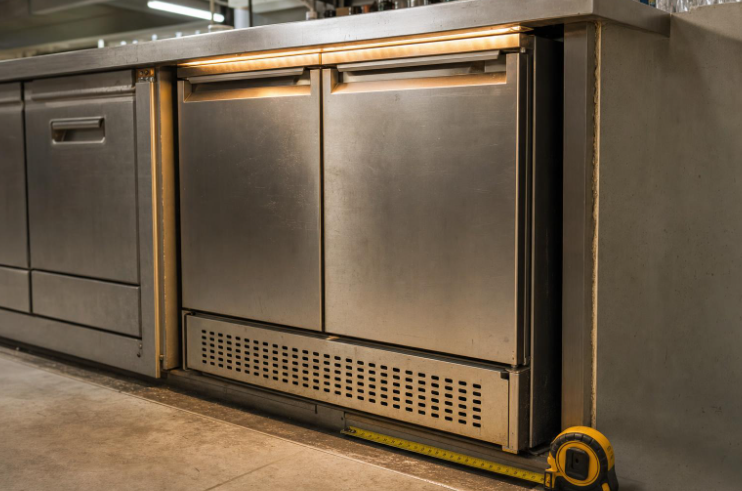
Ventilation decides where a fridge can sit. Front-vented under-bench models can be built into cabinetry because they draw and expel air at the front. Rear-vented units need clearance behind them, and guidance often cites around 100 mm at the rear as a starting point.
Clearances vary by model, so always check the spec sheet. Blocked grilles are a common cause of failure and can void the warranty, so plan the joinery around airflow rather than fitting the fridge in as an afterthought.
Energy, noise and running costs
The Greenhouse and Energy Minimum Standards (Refrigerated Cabinets) Determination 2024 commenced on 5 October 2024 and applies minimum energy performance standards to refrigerated cabinet classes through an energy efficiency index. The framework references ISO 23953-2 for classifying and testing refrigerated display cabinets.
These cabinets are not required to display an energy rating star label, although voluntary display is allowed if calculated under the determination. To compare units, look at total energy consumption in kWh per 24 hours on the spec sheet. Solid doors generally use less energy than glass, and quieter compressors matter in small venues.
Delivery, install and maintenance
Measure doorways, lifts, and service aisles before ordering, and allow for levelling feet height under the unit. Many commercial back-bar fridges ship with a standard 10 A, three-pin plug for a 220 to 240 V supply, but confirm this per model. For franchise openings, coordinate approved suppliers and local logistics before locking in delivery dates.
What changed recently
The GEMS 2024 determination is now in force. Star labels are not mandatory for these cabinets, but the energy efficiency index applies. From 3 March 2026, commercial ice makers must meet minimum energy performance standards, be GEMS-registered, and display registration numbers.
Where to browse options
Once your spec is settled, it helps to compare formats side by side. If you need to review single, double, or triple-door, upright, wine, or mini formats in one place, you can use the buy bar fridge Australia category to compare common options.
Whatever source you use, confirm the climate class, ventilation type, and plug requirement against the manufacturer’s documentation. A category page such as Outdoor Living Abode can make shortlisting easier, but the compliance details still live on the product specifications.
A 10-point spec to copy into your fitout brief
If you are comparing models through Outdoor Living Abode or another retailer, keep this checklist beside the spec sheets.
- Use case: drinks only, or food and dairy included.
- Capacity in litres and shelf spans for peak trade.
- Door count and hinge or sliding configuration.
- Climate class: Class 4 minimum indoors, Class 5 for hot or outdoor areas.
- Product temperature class: M1 if storing perishables.
- Indoor or outdoor rating, including IP rating where relevant.
- Ventilation plan and required clearances per the spec sheet.
- Total energy consumption in kWh per 24 hours.
- Plug and amperage, with the 10 A requirement confirmed per model.
- Delivery path, doorway sizes, and levelling allowance.
FAQ
Can a bar fridge store food for service?
Yes, but it must suit the task. For potentially hazardous food, FSANZ requires it to be held at 5 °C or colder, or 60 °C or hotter, unless an equally safe alternative system can be demonstrated.
Are outdoor bar fridges the same as stainless steel fridges?
No. Confirm the outdoor rating, IP rating where relevant, climate class, and ventilation clearances on the manufacturer’s spec sheet before using any unit outdoors.