Australians and swimming go together like fish and the ocean. We Aussies have a strong swimming culture, which is unheard of in this part of the world, and most of our dwellings are in one way or another associated with coastal living. According to the 2021 State of the Environment Report, no less than 87% of all Australians live less than 50km from the coast, and it’s estimated that around 75% of us know how to swim. Therefore, it is no wonder that in Sydney, according to Roy Morgan Research, approximately 16% of all dwellings have access to a private swimming pool.
The connections between us and water are quite self-evident. Australia is a dry and hot continent in which summer temperatures often reach unbearable levels. The highest temperature ever recorded in Australia was 50.7 °C, and the average February temperature for cities like Perth is an uncomfortable 31.2 °C. The popularity of swimming pools in Australia is rising, as the climate, at least in the last couple of years has started to become drier and drier. Plus, for many Aussies, pools are seen as something of a socialisation space, and they represent the essential element of the quintessential residential dream.
Who doesn’t love a good barbecue when the sun is shining, the children are playing and the water is just right? Pools are a private space for recreation, they help us cool off during the hot summer months, and they are a desirable addition to any property, which can add substantially to their market valuation. But there is a problem. If you invest in a pool, you will also need to invest in a high-quality pool fence, as the last thing you realistically want is to put the safety of your loved ones into question.
Why Is Fencing in Sydney So Important?
There are a couple of reasons. Even though approximately 75% of all Australians know how to swim, these values do not realistically apply to young children, or, of course, to our pets. Nearly half of Australia’s year-six students cannot tread water for longer than two minutes, and this is quite a problem if you’re the owner of a property with direct access to a private pool. Injuries or accidental drownings are something that no one wants to think about. But realistically, the only way to 100% prevent them is to install a physical barrier that will keep your young children and animals away from the risks associated with the pool.
Fencing in Sydney is a residential requirement, and it represents a way to enhance the privacy of your pool, ensure its safety and control who has round-the-clock access to it. Plus, in some cases, a high-quality pool fence can enhance the look of your backyard, complement the aesthetics of your pool, and potentially have a positive effect on your property’s market desirability. Sure, they are not the cheapest things in the world. But when considering the value and security they will bring to your property, fences for pools are a downright bargain.
What Are the Legal Ramifications?
In Sydney, the installation of a pool fence is not just optional. It is an obligation for all residential properties that have direct access to a swimming pool. According to the Swimming Pool Acts of 1992, and its subsequent additions, such as the Swimming Pools Regulations of 2018, all houses in NSW must be equipped with special barriers around swimming pools that can prevent unsupervised access by children under five years old. It doesn’t really matter how deep the pool is, or its square footage, as the act defines swimming pools as any water-containing structure, directly accessible by humans, with a depth that’s above 30cm.
As for the requirements for fencing, per the specifications of the Swimming Pool Acts, a pool fence must have a minimum height of at least 1.2m and be well-maintained regardless of the season. The horizontal climbable bars of the fence, if present, must be spaced at least 90cm apart and as for vertical bars, there should be no gaps that are larger than 10cm. Not least, for fences with perforated mesh barriers with a height of 1.2m, the holes of these barriers cannot exceed 13mm.
That’s not all, however. All pools need to have a 90cm non-climbable zone around them, that’s free of trees, shrubs, toys, ladders, or pots which can be easily climbed by children. The purpose of these measures is simple. To make accidental drownings a thing of the past. Did it work? Yes, at least according to available data. Multiple external studies have determined that pool fences significantly reduce the risk of drowning. In fact, between 1992 and 1997, out of the 38 pools in which drowning occurred, no less than 87% of them did not fully comply with fence regulations.
What Pool Fence Can I Purchase?
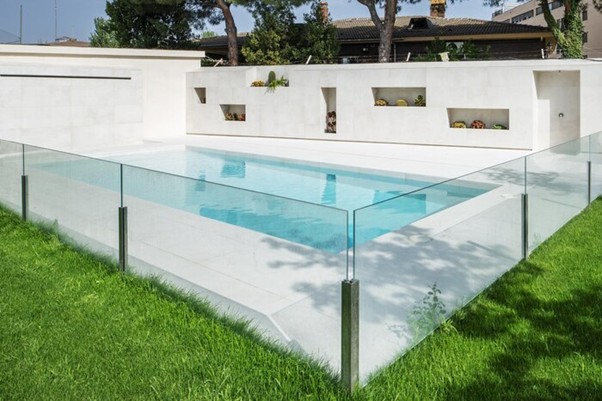
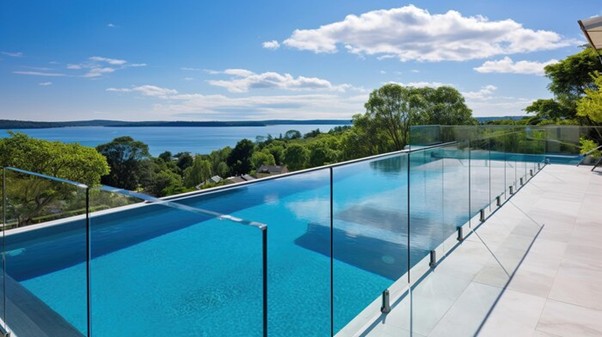
It depends on what you’re looking for. Do you prioritise style, and are you trying to make your backyard feel like a modern gathering place, in which safety goes hand in hand with practicality? In such a case, a frameless glass fence can be the right choice for your requirements. These kinds of fences are built from high-quality 10-12mm glass panels, which are ground-fixed and coated to resist the chemicals present in pool water. Frameless glass fences look modern, are impact-resistant, and are widely available. However, are you thinking of something more cost-effective? Then, you could consider a semi-frameless design, which will include aluminium posts between the glass panels.
You are not really convinced about glass-panel fences, and you are looking for something a bit more straightforward? In that case, the most widely available solution will be to invest in an aluminium fence, with a vertical bar design. Aluminium fences are affordable, they require minimal maintenance, and go well with the vast majority of the architectural characteristics encountered with Aussie homes. Finally, if costs are a big concern, you could always go with a mesh fence. Will it look good? No, not really. It will get the job done, though. However, if you truly want to enhance the valuation of your property, you should at the very least consider a tubular fence.