
Payroll in Australia changed again in 2026. Payday Super now requires super to be paid with each pay run, while STP Phase 2 data and Modern Award rules still need clean handling.
I reviewed seven Australia-ready payroll platforms for franchisors, franchisees, accountants and bookkeepers. I checked STP2 lodgment, super workflows, award support, self-service and live pricing where official pages showed figures. MYOB came out on top for Australian SMBs.
Key takeaways
- MYOB is the best overall payroll platform for Australian SMBs and franchises. STP, Pay Super, self-onboarding and the MYOB Team app feel joined up.
- Xero is best for Xero-led accounts. It sends STP-compliant reports to the ATO and keeps payroll close to the books.
- QuickBooks Payroll suits teams needing Modern Award support. Employment Hero powers the award and pay condition tools.
- Employment Hero Payroll suits larger workforce setups. HR, rostering and award automation work together.
- Payroller, Reckon and ClockOn cover leaner use cases. They suit micro-business STP, budget payroll and shift-based award support.
How I tested these payroll platforms
I weighted four areas: STP2 lodgment and Payday Super compliance; Modern Award interpretation; rostering, time and employee self-service; and pricing transparency. Built-in award tools, staff apps and clear official pricing scored higher than broad feature claims.
I also looked for all-in-one payroll platforms that could consolidate payroll across sites.
What payroll software needs to do in Australia in 2026
Australian payroll software must report wages, tax and super through STP, handle STP Phase 2 details and support Payday Super, which now requires super contributions to be paid at the same time as wages. For shift-based franchises, it should also reduce manual award checks and give staff easy payroll access.
1. MYOB
MYOB pros
- Built-in STP reporting straight to the ATO
- MYOB Team app for leave, rosters, timesheets and payslips
- Employee self-onboarding via a secure form for personal, tax, bank and super details
- Simple tax, super and leave calculations inside the pay run
- Scales from Payroll Only up to Business Pro with payroll added on
- Transparent per-employee add-on pricing on Business Pro
MYOB cons
- Per-employee fees can add up as headcount grows
- Very complex award setups may still need specialist review
My experience with MYOB
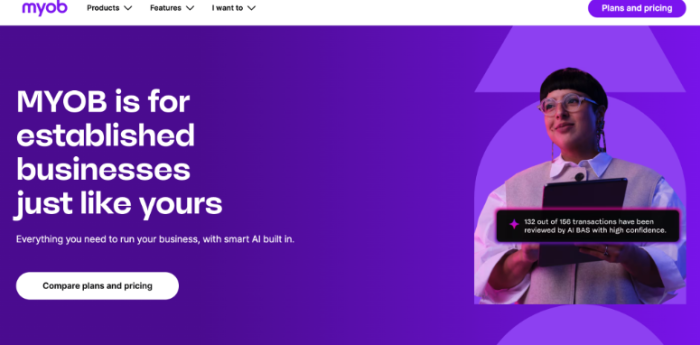
MYOB is my top overall pick for Australian SMBs and franchises. The pay run is easy to follow, and STP reporting sits inside the same workflow instead of feeling like a separate compliance job.
The MYOB Team app stood out in a multi-site context. Staff can view payslips, request leave and check rosters, while managers handle timesheets in one place.
Onboarding is practical because MYOB supports self-onboarding through a secure form for personal, tax, bank and super details. With Payday Super now in effect, keeping pay runs, STP and super in one connected flow is a real advantage.
MYOB pricing
MYOB Business Pro starts at $21 per month (with introductory pricing of 70% off for 6 months, then $70 per month). Payroll can be added for $3 per employee per month on Pro, so costs scale directly with headcount. MYOB Business Lite is available at $12 per month for smaller teams.
2. Xero Payroll
Xero Payroll pros
- Compiles and sends STP-compliant reports to the ATO each pay day
- STP Phase 2 coverage for expanded reporting
- Xero Me app for employee self-service
- Large app marketplace for add-ons
- Plan tiers bundle payroll for a defined number of people
Xero Payroll cons
- Payroll person caps are tied to each plan
- An extra per-person fee applies above 100 employees
- AU subscription prices increased from 1 July 2026
My experience with Xero Payroll
If your franchise or advisor already runs the books in Xero, Xero Payroll is a natural fit. It keeps payroll, reporting and accounting close together, cutting down on tool switching.
Xero compiles and sends STP-compliant reports to the ATO each pay day, and STP Phase 2 coverage is built into the workflow. The Xero Me app handles staff self-service, though advanced award needs may need add-ons.
Xero pricing
Xero’s Comprehensive plan is $107 per month and includes payroll for 5 people. Ultimate 10 is $143 per month and includes payroll for 10 people. On Ultimate 100, Xero charges $2 per person after 100 employees, up to 200 people. These figures reflect the price increase that took effect on 1 July 2026.
3. QuickBooks Payroll (powered by Employment Hero)
QuickBooks Payroll pros
- Pre-built Modern Award interpretation out of the box
- Pay Conditions Engine for enterprise agreements
- EH Work App for employee self-service
- STP and ATO-compliant reporting
- Super payments supported via Beam
QuickBooks Payroll cons
- Billed per employee, so costs scale with headcount
- Features live inside an integration layer, which can add setup steps
My experience with QuickBooks Payroll
QuickBooks users get a more Australia-specific payroll setup through the Employment Hero engine. The Pre-Built Modern Award Interpretation and Pay Conditions Engine help with penalties, allowances and enterprise agreement rules.
Super payments run through Beam, and the EH Work App gives employees a self-service route. The integration layer may take more setup than a simpler payroll tool, but it is useful for shift-heavy teams already using QuickBooks.
QuickBooks Payroll pricing
QuickBooks bills $6 per employee per month on Standard Payroll in Australia. Advanced Payroll has a $10 base plus $6 per employee. Your base QuickBooks Online subscription is separate, so include it when comparing total cost.
4. Employment Hero Payroll
Employment Hero Payroll pros
- STP Phase 2 reporting listed on its Payroll page
- Fair Work compliant Modern Award calculations
- Native HR integration alongside payroll
Employment Hero Payroll cons
- Implementation and final pricing can be heavier than a pure payroll tool
My experience with Employment Hero Payroll
Employment Hero Payroll fits teams with complex penalty and allowance rules. Its Payroll page lists STP Phase 2 reporting and Fair Work compliant Modern Award calculations. The broader HR tools suit groups that want one system across payroll, people data and rostering.
Employment Hero Payroll pricing
Employment Hero surfaces payroll pricing on its site, but the full total can depend on plan and headcount. Treat listed figures as a starting point and confirm the final cost for your team.
5. Payroller
Payroller pros
- Very low per-employee pricing
- STP2 enabled reporting
- Payday Super automation built into the pitch
Payroller cons
- Limited depth for complex award or EBA scenarios
My experience with Payroller
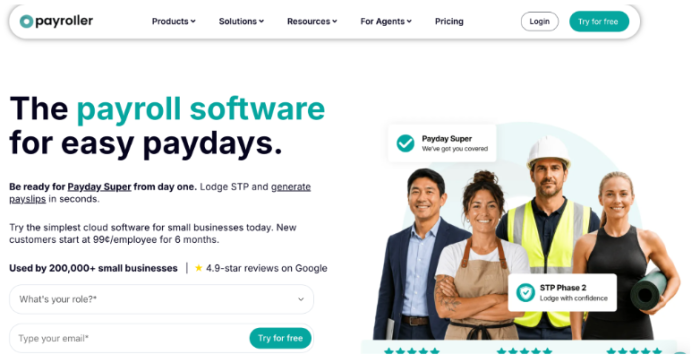
Payroller is the low-cost STP option for micro-businesses. Tradies and very small teams can meet basic payroll reporting needs through simple mobile and web apps. It also automates the Payday Super requirement, now that super must be paid with every pay run.
Payroller pricing
Payroller’s Standard plan advertises $0.99 per employee for the first 6 months. After that it is $5.50 per employee per month with a $22 minimum, or $3.99 per employee per month billed annually with a $15.96 minimum.
6. Reckon Payroll
Reckon Payroll pros
- STP-compliant payroll options
- Cloud payroll from a low monthly base
- Multiple tiers to match team size
Reckon Payroll cons
- Some advanced automations, including complex award rules, may need add-ons
My experience with Reckon Payroll
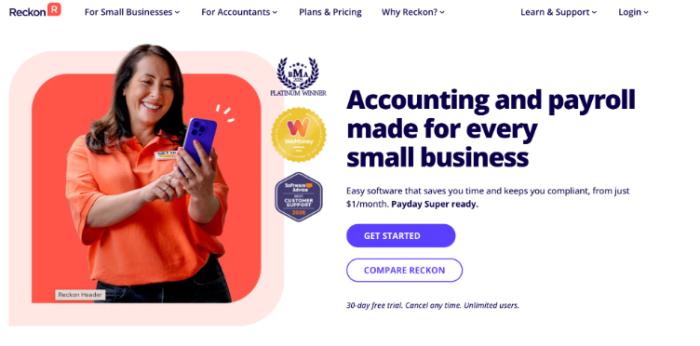
Reckon gives small teams a simple path to STP and core payroll. It works best when pay rules are straightforward and the priority is keeping costs controlled. More complex award setups may need extra tools or advice.
Reckon Payroll pricing
Reckon’s tiers are Payroll Essentials at $16 per month, Payroll Plus at $32 per month, and Payroll Premium at $60 per month. Choose based on headcount and automation needs.
7. ClockOn
ClockOn pros
- STP2-compliant payroll
- Built-in award interpretation
- Integrated rostering and attendance
ClockOn cons
- Award setup may need implementation time
My experience with ClockOn
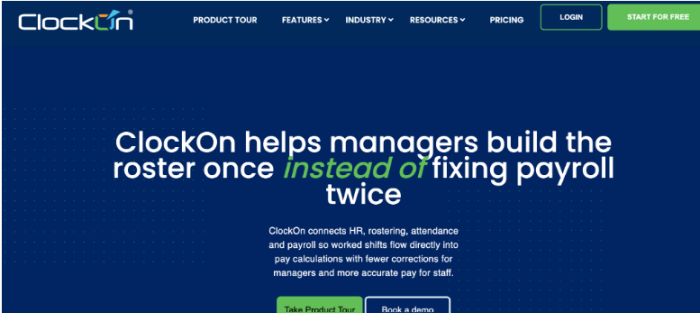
ClockOn pairs payroll with rostering and attendance, which suits hospitality and retail teams. Its award interpretation support is useful where shift patterns and penalty rates drive payroll. The per-employee pricing is easy to understand as teams grow, but allow time to configure awards correctly before using it across sites.
ClockOn pricing
ClockOn shows Standard from $2.45 per employee per month and Pro from $7 per employee per month. Both tiers are STP2-compliant, so the decision comes down to the HR features you need.
Conclusion
MYOB is my top pick for Australian SMBs and franchises in 2026. Its built-in STP reporting, Pay Super flows, employee self-onboarding and MYOB Team app create the most practical all-round setup for multi-site payroll now that Payday Super is in effect.
Xero is the runner-up for businesses already built around Xero accounting. QuickBooks Payroll is strong for QuickBooks users who need Modern Award tools, while Employment Hero Payroll suits larger workforce operations. Payroller, Reckon and ClockOn are best for narrower needs.
Before choosing, check live pricing, employee caps and any promotional windows. Then test one real pay run, including super, leave and STP, against your own roster and award mix.