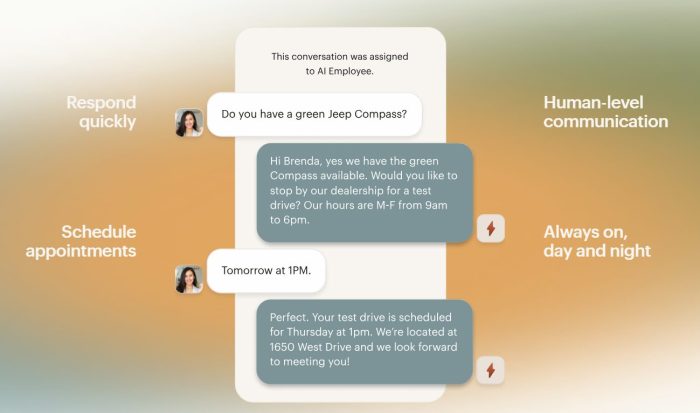
Businesses today are overwhelmed. Leads arrive through websites, text messages, social platforms, phone calls, and booking forms. Add to this that customers expect instant replies and it’s not hard to see why so many teams cannot always keep up. That’s also why response time has become a competitive advantage and availability has become a growth constraint.
Most businesses rely on people to manage inbound demand. The problem is that that model breaks under volume. Staff miss calls. Messages sit unanswered. Follow-ups fall through the cracks. Customers move on.
Traditional automation promised relief. Chatbots and autoresponders were meant to fill the gaps but in practice, they created new problems. They feel rigid, miss context and frustrate customers who want real help.
This gap between customer expectation and human capacity is where AI Employees are emerging. Not as a novelty, but as a new operational layer.
What Is an AI Employee?
An AI Employee is a digital worker designed to handle real business tasks across customer communication channels. It’s not a chatbot, it’s not a virtual assistant and it’s not simple automation.
Chatbots follow scripts, virtual assistants wait for instructions and rule-based automation reacts to triggers. However, an AI Employee is different because it operates with complete context and intent. It’s always available and it understands what the customer is trying to do, taking action on behalf of the business.
An AI Employee can respond to enquiries, qualify leads, book appointments, follow up conversations, and escalate issues when and if it’s needed. It works continuously and won’t tire when the pressure ramps up.
This is a new category of software that’s easiest to describe as less like a tool and more like an extra role. Platforms like Podium AI Employee are helping define this category by combining real-time communication, business context, and automated action in one system.
How an AI Employee Works
An AI Employee sits at the point where customers interact with your business. It receives inputs from messages, calls, web chat, and online forms.
It interprets intent and recognises what the customer wants based on language, timing, and context. Your business rules and priorities are always put into practice and once intent is clear, it takes action.
That action might be answering a question, confirming availability, booking an appointment, sending a follow-up, or routing the conversation to a human team member.
Over time, performance improves as it adapts to real customer behaviour. The system learns which responses resolve issues and determines which hand-offs convert best.
The goal is not artificial intelligence for its own sake; it’s reliable execution at scale.
Where AI Employees Sit in Your Business Stack
AI Employees operate right at the centre of your business. Let's look at some of the roles that can reap the rewards:
- They support sales teams by qualifying leads before human contact.
- They support customer service by resolving routine enquiries.
- They support operations by keeping workflows moving.
This is not about replacement but freeing up more time for your staff to concentrate on the important parts of their role. Human teams focus on judgement, empathy, and complex decisions. AI Employees handle volume, speed, and consistency.
The result is a cleaner hand-off between automation and people, one with less noise and better outcomes.
Real-World Use Cases by Industry
For service-based businesses, AI Employees capture leads and book jobs. They do this by responding after hours and following up on any missed calls that could’ve been missed.
For retail and ecommerce, they answer product questions, track orders, and recover abandoned enquiries, guiding customers to purchase or support.
For healthcare and professional services, they manage appointment scheduling and confirmations. Front-desk load is reduced and consistency and compliance is maintained.
For multi-location businesses, they route enquiries correctly. They apply local rules and scale without duplicating staff.
Across industries, the pattern is the same. Faster responses lead to more conversions and consistent handling is a surefire way of building real trust.
Seeking the Benefits of an AI Employee
The most immediate benefit of an AI Employee is speed. Customers receive answers at the moment they expect them, without having to wait for business hours or staff availability. That immediacy has a direct impact on conversion. Interest is captured while intent is still high instead of fading due to delays.
Any administrative workload is reduced to. Routine tasks such as responding to common questions, confirming bookings, or following up on missed enquiries no longer require constant manual effort from staff. Teams are free to focus on higher-value work, the work that genuinely benefits from human judgement and relationship building.
Customer experience also benefits. Interactions feel responsive, relevant, and consistent, because every inquiry gets the same level of attention regardless of time, channel, or volume. In short, consistency becomes a strength rather than a challenge.
The Common Misconceptions About AI Employees
Many people assume AI Employees replace staff. In practice, they only reduce pressure on teams by taking on repetitive and time-sensitive interactions.
Some also worry they sound robotic. Modern systems are built around natural language, context, and conversation history, meaning any interactions are far more human than traditional chatbots or scripted automation. When implemented well, customers shouldn't notice the handoff between AI and human support.
There is also a belief that AI Employees are complex to manage or require technical expertise. In reality, most are configured through clear rules, workflows, and human oversight rather than constant tuning.
Finally, many assume this technology is only viable for large organisations. In truth, small and medium-sized businesses often see the greatest benefit. The reason for this is because always-on coverage closes the gaps that limited staff numbers cannot. These systems are best when they support people, not when they attempt to imitate them.
What the Future Holds for AI Employees
AI Employees are moving from reactive to proactive roles. They will very soon be able to anticipate needs, follow up before customers ask and operate across channels without reset.
Personalisation will deepen. Conversations will reflect history and preferences.
Autonomy will increase with clear human oversight. Control will remain with the business.
AI Employees will never be a replacement for human relationships. They protect those relationships by ensuring no enquiry is missed, no lead is ignored, and no customer feels forgotten.
For businesses thinking long term, this is not a trend to observe from a distance. It is a capability to adopt deliberately and integrate into the way modern customer engagement works.