
Small businesses across Australia (AU) and New Zealand (NZ) are entering 2026 with record confidence, yet behind the optimism lies a call for focus, as rising costs and shifting customer expectations test their resilience.
Thryv® (NASDAQ: THRY), Australia and New Zealand’s provider of the leading small business marketing and sales software platform, has launched its inaugural 2025 Business Index and Consumer Report for Australia and New Zealand, the first trans-Tasman survey to capture both small business sentiment and consumer expectations at scale.
The findings from 4,055 respondents (2,032 small-business decision-makers and 2,023 consumers) reveal small-medium businesses (SMB) are confident in future growth, but are challenged by credibility, service consistency and digital delivery.
While 57% of Australian SMBs and 64% of New Zealand SMBs report revenue growth over the past year and around half have increased staff and wages, between 42% (AU) and 47% (NZ) of consumers say they would switch businesses if digital tools such as online booking or mobile-friendly websites are not available. This highlights a widening gap between business readiness and customer reality.
Small business confidence is running high
Small businesses in both Australia and New Zealand are upbeat about their economic prospects. In Australia, 54% believe the economy will improve in the next six months, while 66% of New Zealand SMBs share that view. Revenue sentiment is strong: 64% of Australian and 72% of New Zealand business owners expect revenues to increase, with 62% (AU) and 68% (NZ) anticipating customer growth.
Elise Balsillie, Head of Thryv Australia and New Zealand, said the scale of optimism should not be underestimated.
“Confidence of this magnitude is rare in the current climate. Small businesses on both sides of the Tasman are backing themselves with plans to hire, invest and grow. However, optimism alone won’t close the credibility gap. Consumers are rewarding businesses who deliver consistency, connection and convenience, not just enthusiasm,” Elise said.
Investment sentiment mirrors that confidence: 51% of Australian and 55% of New Zealand SMBs expect marketing budgets to increase, while 52% (AU) and 56% (NZ) plan to expand software spending.
“Businesses are actively investing in the very tools that drive growth - marketing, technology and infrastructure,” Elise said.
“That kind of intent matters, especially when 71% of SMBs in both Australia and New Zealand report rising input costs, and 67% (AU) and 65% (NZ) have increased wages. Every digital investment has to earn its place through customer loyalty, productivity and cash flow gains.”
Consumers see credibility gap in service
Despite these positive signals, the index and report reveal a defining challenge - the gap between SMB perceptions of service and what consumers experience.
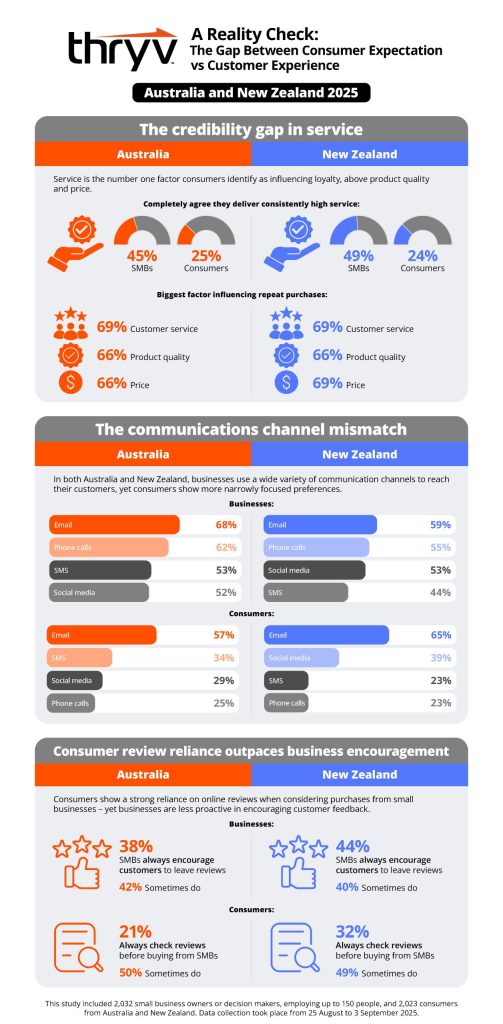
A similar credibility gap exists in digital confidence. While 72% of Australian SMBs and 75% of New Zealand SMBs believe they have a strong online presence across websites, social media and reviews, only 49% of Australian and 52% of New Zealand consumers agree.
In New Zealand, 49% of SMBs completely agree they deliver consistently high service, however only 24% of consumers agree. In Australia, 45% of SMBs completely agree, compared with 25% of consumers. Service is the number one factor consumers identify as influencing loyalty, above product quality and price. 69% of consumers across both countries rank customer service as the biggest factor influencing repeat purchases, followed by product quality (66%) and price (66% AU/69% NZ).
According to Elise, the service gap has become the single biggest barrier to growth.
“Businesses believe they deliver excellence; however, consumers hold them to a higher bar. In a market where loyalty is fragile and prices are rising; credibility is earned through service. Australians and Kiwis alike say friendly and responsive communication - 63% in Australia and 68% in New Zealand – builds trust more than any marketing claim. The businesses that close this trust gap through authentic communication will define the next wave of growth for both countries.
Margin pressures and payment strain
Across both markets, the majority of SMBs report higher input costs (71% AU, 71% NZ) and around two-thirds have increased wages, while payment delays remain a common frustration, especially in New Zealand.
“Revenue without profit is an empty victory. The data shows owners are growing top line sales, however rising costs and late payments are eroding the bottom line. Consumers are increasingly price-sensitive, with 57% of Australians and 61% of New Zealanders citing higher prices as the main reason they would walk away from a small business. That combination makes it harder to invest in staff or service – the very things that build customer trust,” Elise said.
Burnout tightens grip
Owner wellbeing is another pressure point. 49% of New Zealand SMB owners and 45% of Australians have considered stepping away from their business due to workload and burnout. Among New Zealanders, a majority who have considered exit have already begun the process.
“Burnout at this scale is an economic issue, not just a personal one. When almost half of SMBs are contemplating stepping away, it undermines continuity, succession and the stability of local economies. For consumers, that instability shows up as inconsistency – one week’s great experience followed by another that misses the mark. Supporting owner wellbeing is now part of sustaining customer trust,” Elise said.
Financing strategies diverge
Access to finance has improved in both markets -84% of Australian and 83% of New Zealand SMBs say it’s easier to secure financing now when compared to six months ago.
However, approaches differ: Australians are equally likely to rely on personal savings as bank loans, while New Zealanders lean more on institutional credit.
“Elise said, “Easier access to finance is a welcome tailwind, and the data shows business owners are drawing on a range of funding sources to support their plans. The differences between Australia and New Zealand are subtle, reflecting individual preferences rather than divergent strategies. What matters most is how these choices translate into action - whether that is modernising operations, strengthening digital capability or improving the customer experience. Confidence is returning and customers will see it in the way businesses invest, innovate and engage.”
Digital adoption and consumer expectations
Awareness of government programs for digital adoption is higher in New Zealand (57%) than Australia (52%). However, awareness doesn’t always lead to action.
Consumers’ expectations are climbing fast. In New Zealand, 52% expect small businesses to have a mobile-friendly website and 51% want online booking options; in Australia, 43 percent expect both. Social media updates matter to 43% of Kiwis and 32% of Australians, reinforcing that visibility and convenience now shape purchasing decisions.
This expectation gap is sharpened by perception. While most SMBs believe they are digitally ready, up to 47% of consumers say they would still switch providers if core digital tools are missing.
According to Elise, being digitally confident and being digitally aligned are two different things.
“Our data shows that between 42% (AU) and 47% (NZ) of consumers would likely switch to another provider if a business does not offer key digital tools such as online booking, mobile-friendly websites, or online payments. Consumers have told us how they prefer to engage - through email, trusted reviews and seamless online experiences. SMBs that rely on the wrong channels risk losing loyalty before the sale even begins,” Elise said.
Consumer voice and what drives loyalty
Consumers across both markets are clear on what keeps them coming back: service, product quality and price. High prices remain the top deterrent. Reviews and recommendations have become the new word-of-mouth currency - 64% of Australians and 62% of New Zealanders say they are likely to leave a review after a purchase, and 21% of Australian consumers and 32% of New Zealand consumers always check reviews before buying.
For Australian consumers, word-of-mouth (19%) and online searches (14%) remain top discovery methods, while New Zealanders increasingly rely on social media (16%) to find local providers.
“The consumer voice in this report is loud and consistent. Service, quality and price drive loyalty; high prices stop purchases. Trust is built through transparency - timely responses, authentic reviews and visible communication. Businesses now have the blueprint for what consumers value most. The challenge is acting on it diligently and efficiently.”
A benchmark for growth
The 2025 Thryv Business Index and Consumer Report is the first dual-lens dataset for the region, capturing sentiment from both business owners and customers. With 4,055 respondents surveyed, it provides an unparalleled benchmark for policymakers, business leaders and community stakeholders.
“What makes this study powerful is its depth and balance. It shows a region that is optimistic, investing and hiring, however, it also shows where credibility is under pressure,” Elise said.
“When 63% of Australians and 68% of Kiwis say friendly communication drives trust, service can no longer be treated as a soft skill – it’s a hard metric for growth. Optimism will translate into sustainable success only when service, digital alignment and owner wellbeing move together.”
About Elise Balsillie
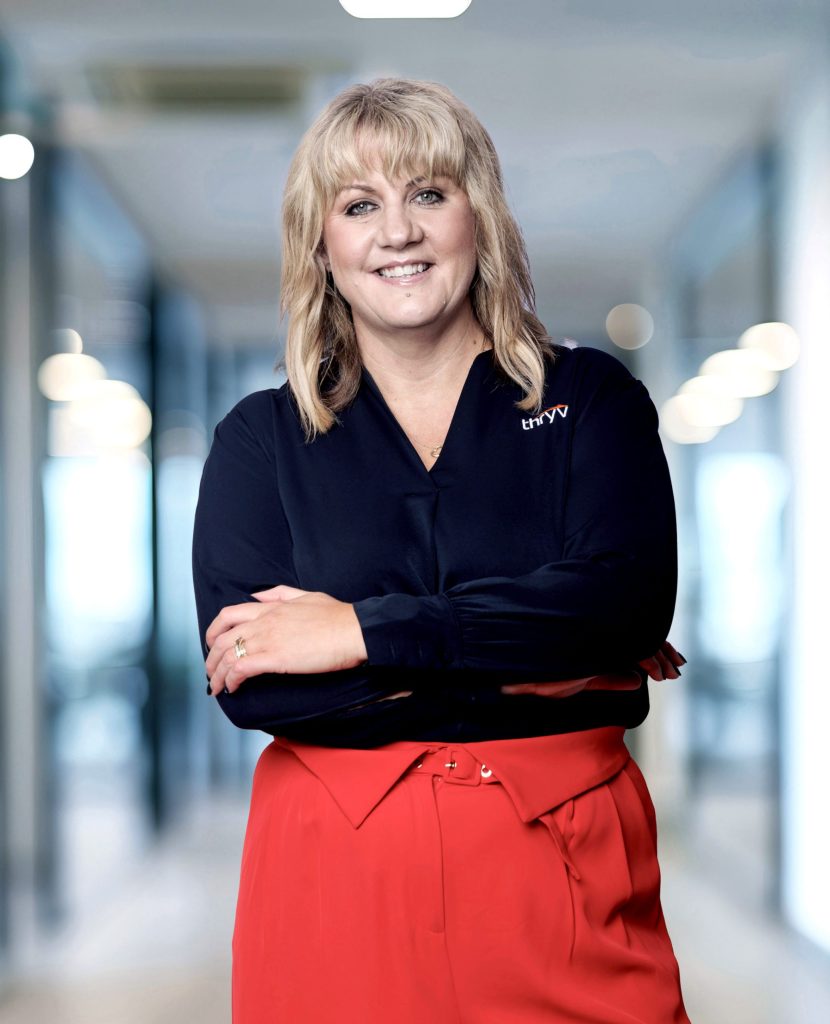
As Head of Thryv Australia and New Zealand, Elise Balsillie is a leader with a deep passion for empowering small businesses to grow and adapt in the dynamic digital environment.
With more than 25 years of experience across media, education, and technology, she has spent two decades at Thryv, driving its success. Elise leads teams across customer channels, focusing on transforming how small businesses embrace digital solutions.
Elise’s greatest reward comes from helping businesses streamline operations, enabling them to grow, hire and focus on what they love. Under her leadership, Thryv has earned the “Employer of Choice” recognition for two consecutive years, reflecting her commitment to people and culture. An engaging public speaker, Elise regularly shares her expertise at industry conferences and podcasts, offering insights on digital transformation, organisational growth and employee engagement.
Balancing her professional role with her personal life as a mother and wife, Elise advocates for work-life balance and continuous learning. She fosters innovation within her team, encouraging collaboration and new ideas. When not at work, Elise enjoys time outdoors in country Victoria and supporting her boys at their sports events.