
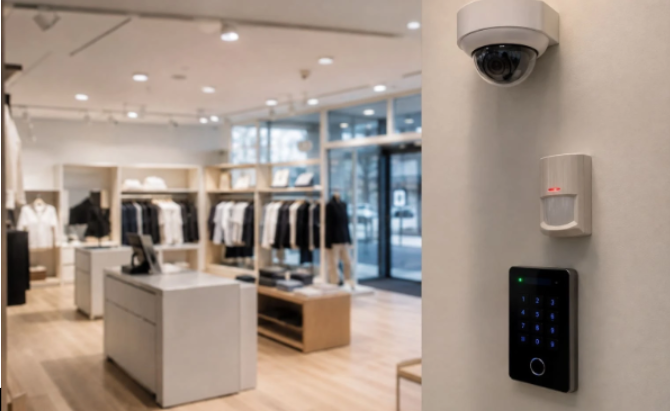
Security in a franchise business is rarely limited to preventing someone from forcing a front door after closing time. A typical site may have employees arriving before opening, deliveries through a rear entrance, managers staying late, stock kept away from public areas and cleaners entering after trading hours. Once several people share responsibility for opening and closing, a basic alarm with one common code can become difficult to manage.
A useful security system has to match those routines.
For a retail store, clinic, restaurant, showroom, professional office or service franchise, that normally means looking at three issues together: how the premises are physically protected, who is authorised to operate the alarm, and what happens when something unusual occurs outside normal business hours.
The equipment matters, but the operating plan matters just as much.
Franchise Sites Have More Than One Security State
Most commercial premises do not simply alternate between “open” and “closed”.
Consider a retail franchise that trades until 6:00 pm. Customers may leave at 6:00, but two employees remain to count stock. A cleaner arrives at 7:00. The manager returns at 8:00 to collect paperwork. At 6:30 the following morning, another staff member enters through the rear door before the shopfront opens.
A security system designed only around published trading hours will not handle these movements well.
The alarm design needs to account for the actual operating states of the premises, such as:
normal trading;
staff working after customers leave;
cleaning or contractor access;
deliveries outside trading hours;
overnight vacancy;
early staff arrival;
temporary closure of part of the premises.
These distinctions affect detector placement, arming arrangements and user permissions.
They also help reduce false alarms. A motion detector that is perfectly positioned for overnight intrusion protection may cause repeated unwanted activations if cleaners regularly enter the same area after the rest of the building has been armed.
Shared Alarm Codes Create Avoidable Problems
Many older business alarms are operated with one code known by most of the staff.
That works until nobody can identify who disarmed the premises at 6:20 am, who forgot to arm it at night or whether a former employee still knows the current code.
Individual alarm users provide a cleaner arrangement.
An owner may have administrative control, managers may be authorised to arm and disarm the premises, and selected employees may receive only the permissions required for their role. When someone leaves the company, that user's alarm access can be removed without changing the credentials used by everybody else.
This user lifecycle is important in businesses with regular staff turnover.
Access should be reviewed when:
a new employee starts;
a person is promoted to a supervisory role;
responsibilities change between locations;
a contractor no longer needs access;
an employee leaves the business.
Alarm permissions, however, should not be confused with a full access-control system.
Giving an employee permission to disarm an alarm does not automatically provide controlled management of doors, locks, access schedules or detailed entry permissions. Businesses that need electronic door control, card readers, scheduled door access or records of physical entry may require a dedicated access-control solution in addition to the alarm.
Keeping these functions separate during planning prevents unrealistic expectations about what the intrusion system is supposed to do.
Start With the Doors People Actually Use
The front entrance receives the most attention because it is visible, but it is not always the most important security point.
For many commercial sites, a rear staff door or delivery entrance presents a more complicated risk. It may face a service lane, loading zone or area with limited natural surveillance. Employees may also use that entrance before opening or after closing.
Other locations worth assessing include:
accessible windows;
roller doors;
stockroom entrances;
office doors;
delivery areas;
internal corridors;
storage rooms;
cash-handling areas;
side passages;
entrances connecting a tenancy to a shared building area.
Perimeter contacts can identify when protected doors or windows open, while internal detectors provide another layer of intrusion detection.
The correct combination depends on the premises.
A small office with one entrance and an internal corridor requires a different layout from a retail store with a shopfront, rear stockroom and loading door. A warehouse tenancy with roller doors and long internal distances needs another approach again.
Installing the same detector package at every franchise location may simplify purchasing, but it does not guarantee equivalent protection.
Opening and Closing Need Clear Responsibility
Closing a business is a security procedure, not just the final task of the shift.
Someone needs to confirm that customers have left, vulnerable doors are secured, staff-only areas are clear and the required alarm areas have been armed.
Problems arise when everybody assumes somebody else completed the process.
Individual alarm users make it easier to establish responsibility because system events can be associated with specific authorised users rather than one shared code.
The same principle applies in the morning.
If several managers rotate opening duties, each person can operate the system under their own credentials. When an unexpected event occurs, the owner has a clearer starting point for reviewing what happened.
For multi-site franchise operators, standardising opening and closing procedures is often more valuable than trying to make every physical security installation identical.
Staff can follow the same process at each location even when detector positions and door layouts differ.
False Alarms Need to Be Designed Out
False alarms are not always caused by faulty equipment.
They can result from poor planning.
Common examples include a cleaner entering an armed area, an employee using a door that was not considered in the original design, stock movement affecting a poorly selected detector location or one part of a building being armed while staff are still working nearby.
Environmental and site conditions also matter.
A detector position that works in a small enclosed office may not be suitable for a warehouse environment. Roller doors, large open areas, changing temperatures, air movement, pets at certain premises and unusual after-hours activity may all influence the design.
Before installation, the security provider needs to understand who occupies the site, where they move and when those movements occur.
That is more reliable than trying to solve repeated false alarms after the system has already been commissioned.
Mobile Notifications Improve Visibility, Not Physical Security by Themselves
Mobile apps have changed how owners interact with alarm systems, but app access is sometimes given more importance than it deserves.
A phone application does not make a poorly designed alarm secure.
Its value is in visibility and administration.
Depending on the chosen system and configuration, authorised users may be able to see alarm events, review system status, receive notifications and manage users without relying entirely on a physical keypad.
This is useful for franchise owners who are not always onsite.
For example, an owner may want to know that an alarm event occurred at a store after closing or confirm whether the system status changed unexpectedly.
The response procedure still needs to be defined.
A notification has little value if nobody knows who is responsible for responding, whether a monitoring provider is involved or what staff should do after receiving an alarm event.
Communication Paths Matter
A commercial alarm depends on more than sensors.
The system also needs a reliable method of communicating relevant events to authorised users or, where configured, a monitoring service.
The appropriate communication arrangement depends on the system and the site. Internet availability, cellular communication, network reliability and the required response process all need consideration during planning.
A franchise operating from a small suburban tenancy has different communications requirements from a larger site where internet services, network infrastructure and alarm monitoring are managed centrally.
Communication failures should therefore be part of the security assessment rather than treated as an afterthought.
Where continuous reporting is important, the installer also needs to confirm which communication options are supported by the selected equipment and how failure of one path affects event delivery.
Stockrooms and Internal Areas May Need Their Own Protection
Not every important area is visible to customers.
A stockroom may contain considerably more value than the sales floor. An office may hold computers, documents or keys. A treatment room, storeroom or equipment area may need to remain restricted even while other parts of the site are occupied.
This creates a distinction between perimeter security and internal protection.
The perimeter focuses on unauthorised entry into the premises. Internal protection deals with movement or access within selected areas.
For some businesses, full internal protection is only required after everybody leaves. Others need selected areas treated differently because employees, contractors or cleaners continue to occupy part of the building.
This is where a site-specific arming plan becomes useful.
The installer needs to understand the operating pattern before deciding which zones or areas belong together.
Where Ajax Fits Into a Commercial Security Plan
Ajax is one option for shops, offices and other small to medium commercial sites that require professionally installed intrusion detection with app-based management.
A system may include door contacts, motion detection, sirens, keypads and individually managed alarm users, with the final device selection based on the building and the required arming arrangement.
For a shop, office or other smaller commercial property, professional Ajax alarm installation for businesses can be planned around staff entry points, vulnerable doors, stockrooms, restricted areas and the way the premises are occupied after normal trading hours.
Wireless equipment can be useful where installing new cabling would be disruptive or impractical, but wireless is not automatically the best solution for every business.
The site still needs to be assessed for building size, construction, communication between devices, detector locations and future expansion.
Large commercial premises, sites with significant existing alarm cabling or buildings requiring many integrated functions may be better suited to a wired or hybrid platform.
The product should follow the site requirements, not the other way around.
CCTV and Intrusion Alarms Solve Different Problems
An intrusion alarm detects defined security events. CCTV records visual evidence.
A franchise business often benefits from both because neither system completely replaces the other.
A camera positioned at an entrance may help establish who entered the premises or provide evidence after an incident. It does not necessarily provide the same active intrusion detection as an alarm detector protecting that area after hours.
Likewise, a motion detector may generate an intrusion event but does not automatically provide recorded video showing what caused it.
Cameras are commonly considered for locations such as:
entrances;
counters;
loading areas;
rear access;
selected customer areas;
stock movement points.
Alarm devices are generally planned around intrusion detection, arming modes and security events.
The two systems may complement each other, but their roles need to remain clear during design.
Do Not Replace a Working Alarm Without a Reason
New technology does not make an older alarm system obsolete by itself.
If the existing panel, keypad, detectors and communication equipment remain reliable, continued maintenance may be more economical than replacement.
An upgrade becomes more compelling when the existing system develops repeated faults, replacement parts become difficult to obtain or the alarm no longer supports the way the business operates.
Operational reasons for considering replacement can include:
persistent keypad or panel faults;
unreliable detectors;
impractical shared user codes;
limited expansion options;
poor remote visibility;
difficulty adding required areas;
unsupported communication equipment;
repeated service costs.
Before recommending a replacement, the existing installation needs to be tested.
The condition of the panel is only part of the picture. Existing cabling, detector locations, sirens, communications equipment and the current security coverage all affect whether repair, partial upgrade or complete replacement provides better value.
Multi-Site Businesses Need Standards, Not Identical Installations
Franchise operators often want consistency across locations, which makes sense.
Employees should not need completely different security procedures every time they move between stores.
However, consistency does not mean installing identical hardware in identical positions.
A shopping-centre tenancy may have one public entrance and a service corridor. A standalone restaurant may have several external doors. A warehouse franchise could have roller doors, office space and a separate dispatch area.
The security standard can remain consistent while the physical design changes.
For example, a franchise group might establish rules requiring:
individual alarm users rather than shared codes;
defined opening and closing responsibility;
prompt removal of former employees;
protection of rear and staff entrances;
documented after-hours procedures;
periodic review of users and alarm events.
Each site can then receive the detector layout and equipment appropriate to its building.
This is a more practical form of standardisation than forcing one hardware package onto every location.
Plan for Staff Changes and Business Growth
Security requirements rarely stay fixed for the life of a premises.
A business may increase trading hours, expand into an adjoining tenancy, add a stockroom or appoint additional managers. A franchisee may eventually operate several sites instead of one.
Those possibilities should be discussed during the original security assessment.
It does not mean installing equipment that is not currently required. It means avoiding a design that becomes difficult to manage as soon as the business grows.
User capacity, additional detection areas, communication options and the ability to expand the system are worth considering before the final platform is selected.
The same applies to administration.
Businesses with regular staff turnover need a simple process for adding, changing and removing authorised alarm users. Former employees should not retain active credentials simply because nobody reviewed the user list.
Good Security Follows the Operation of the Business
The strongest commercial security plan begins with how the premises actually function.
Where do staff enter? Who opens the site? Which person closes it? Is there a rear delivery door? Does cleaning occur after the alarm would normally be armed? Which room contains the most valuable stock? Are some employees permitted to enter areas that others are not? Who receives an alarm notification at 2:00 am, and what are they expected to do next?
Those questions determine the system design more effectively than choosing a fixed package from a product list.
For franchise operators, the objective is not to install the maximum number of detectors or the newest technology available. It is to create a security arrangement that staff can operate consistently, managers can administer properly and the business can adapt as locations, employees and operating hours change.
When intrusion detection, alarm users, communications, CCTV and after-hours procedures are treated as separate but coordinated parts of the same security plan, the result is easier to manage and more closely aligned with the real risks of the premises.