
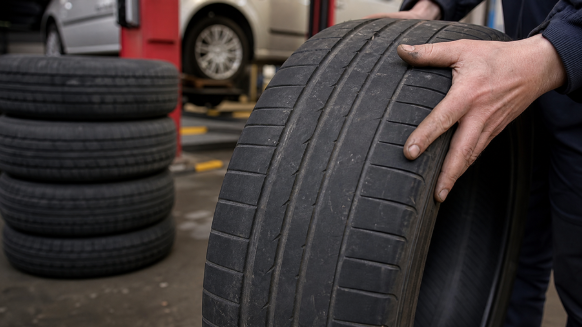
A set of part-worn tyres can look like an easy way to save money, especially when a new set for a family car can run into several hundred pounds. Advertised at a fraction of the price of new rubber, they turn up at independent dealers, market stalls and online listings across the country. For a driver watching every pound, the appeal is obvious.
The problem is that the sticker price rarely tells the whole story. A part-worn tyre has already used up much of its safe life, and buyers often have no reliable way of knowing how it was treated before it reached them. Getting this decision wrong does not just cost money later; it can compromise the one part of the car that actually touches the road.
To help drivers weigh up the choice, experts at Tyres.co.uk, a highly-rated online marketplace for car tyres, say the key is understanding exactly what you are paying for and what you may be giving up on safety and value.
The first thing to grasp is tread depth. The minimum legal tread across the central three-quarters of a tyre, around its full circumference, is 1.6mm. Many part-worn tyres are sold at or only slightly above this figure, which means much of their useful life is already gone. Safety bodies including TyreSafe recommend replacing tyres nearer 3mm, because wet braking performance deteriorates sharply once tread drops below that point. Pay budget-tyre money for something already close to the legal limit and you may be back buying again far sooner than you think.
There are also strict rules for how part-worns must be sold, and not every seller follows them. A part-worn tyre should be marked as such, must have at least 2mm of tread, and must be free of dangerous faults. A tyre is legally defective if it has cuts longer than 25mm or 10 percent of its width, bulges, exposed cord, or is incorrectly seated on the wheel. Damage like this is not always visible from the outside, and internal impact damage from a previous pothole or kerb strike can be almost impossible for a buyer to spot.
Age is another blind spot. Every tyre carries a four-digit code on the sidewall showing the week and year it was made, alongside the size, such as 205/55 R16. Rubber degrades over time even with plenty of tread left, so a part-worn tyre could be several years old before it goes back on a car. Without checking that code, you have no idea how much life is really left in the compound.
It is worth doing the sums honestly. Driving on an illegal tyre carries a fine of up to £2,500 and three penalty points per tyre, so a bargain that turns out to be defective could become very expensive. Tyres are also one of the most common reasons cars fail their MOT, and a part-worn set close to the limit gives you little margin before a retest. Set the low upfront cost against the shorter lifespan and the risk, and the saving often shrinks or disappears.
New tyres, by contrast, come with a known history, full tread and a UK tyre label showing fuel efficiency, wet grip and noise ratings so you can compare like for like. A quick way to check what you already have at home is the 20p test: slot a 20p coin into the main tread grooves, and if the outer band of the coin is visible, your tread may be too low and the tyre needs professional inspection.
A tyre specialist said: "People focus on the price and forget they are only buying whatever life is left in the tyre. With a part-worn you often cannot verify its age, how it was stored or whether it took a heavy knock in a previous life. If you do consider one, insist it is stamped part-worn, check the sidewall date code and the tread, and walk away if the seller cannot answer basic questions."
Before you buy: a quick part-worn checklist
● Confirm the tyre is clearly and permanently marked 'part-worn'.
● Check the four-digit sidewall date code so you know its true age.
● Measure tread; legal minimum is 1.6mm, and part-worns must have at least 2mm.
● Inspect closely for cuts, bulges, exposed cord or uneven wear.
● Make sure the size on the sidewall matches your car and existing tyres.
● Compare the cost per remaining millimetre of tread against a new tyre.
● If the seller cannot answer basic history questions, walk away.
For many drivers, the more predictable route is a new tyre bought at a clear, fully fitted price. A standard fully fitted price typically covers fitting, balancing, a new valve and disposal of the old tyre, with wheel alignment usually a separate add-on, so it pays to check what is included before you commit. Comparing options online lets you weigh grip and longevity rather than guessing at an unknown history.
Drivers who want to see fully-fitted prices upfront and choose their own fitter or mobile fitting can compare new tyres through Tyres.co.uk, a highly-rated online marketplace for car tyres, and know exactly what they are getting from the start.
When it comes to the only parts of your car touching the road, knowing what you are buying is worth far more than a short-term saving.