

By Zahli McFarlane
When you sign up to become a franchisee, it can feel like a whirlwind romance. It’s love at first sight, the Franchisor shows you the successful future together, you get swept up in the support, excitement and you get moved in within the first few months! It’s all lovey-dovey, everything is perfect, until something goes wrong. Like any relationship, they take work from both parties, but when you feel that your Franchisor seems to have sold you a romantic life that ends with a white-picket fence and two kids, but in reality doesn’t get off the couch and can’t be trusted to do the dishes, it’s heartbreaking. No one is perfect, which is why it's important to be prepared and know your rights in this relationship.
As a manager of a family-owned franchised business, I’ve also had experience in a whirlwind romance turned one-sided relationship. Maybe you can make amends with a monthly catch up and some hard work, but not all franchisors are that willing to help. What I can tell you is that it pays to be prepared for the worst.
Can I get out of this nightmare?
The first step is to review the franchise agreement and the legal obligations of each party. This is truly one of the least exciting jobs, but it's the most necessary. Understanding what contractual obligations haven’t been met allows you to recognise the basis of your argument and the franchisor’s. Print off all the materials you were provided with prior to signing the Franchise Agreement, this usually includes the Franchise Agreement, Disclosure Document, Prospective Advice Statement, Prior Representative Statement and usually the Franchise Code (wouldn’t print this last one unless you run a paper store). Start with the Franchise Agreement and highlight all contract provisions that haven’t been met by the Franchisor in one colour and any provisions you haven’t met as a franchisee in another colour.
Considering all of the facts or events that caused the relationship breakdown helps you work out your legal position before you even consult a lawyer. Aim to be as objective as you can be. It can be difficult to recognise your own faults in situations where you feel wronged, but dismissing your own obligations means you are missing a whole chunk of the picture.
Put it in Context
Now is a good time to write out those breaches for both sides and see if you can group issues together. They could be grouped by the reason for breach or an inciting incident. For example, the equipment provided was faulty, therefore clauses related to the franchisor’s obligations to support with maintenance or management of warranties could be impacted or it could be the franchisee’s responsibility to maintain equipment (hard to do when the machine is broken!).
This is a good time to talk to a lawyer. They will give advice on what is worth arguing and what isn’t.
Gather the Evidence
Once you have advice or while you are waiting for the advice, start collecting all the evidence so you can pass it on to the lawyer. The more organised you are, the more efficient the lawyers can be, the quicker the process goes. It’s a process of screenshotting text messages, downloading emails and finding documents, and it takes a long time - trust me! The best thing you can do is keep it organised as you are doing it, especially if it’s multiple issues.
My recommendation is to do this in a personal Google Drive (or OneDrive, whatever you’ve got), this keeps it separate from all your regular day to day business files and creates a copy you can easily send over to a lawyer.
Create a “Master Timeline Document”, this is how I made sure I had all the relevant documents and information. In this document, write out a timeline of the events from memory and note any important documents you need as evidence. Now, when you start collecting the documents, add them into the document and file them according to the relevant issue they relate to. Here are some examples of how I kept all my documents neat and organised the litigation process.
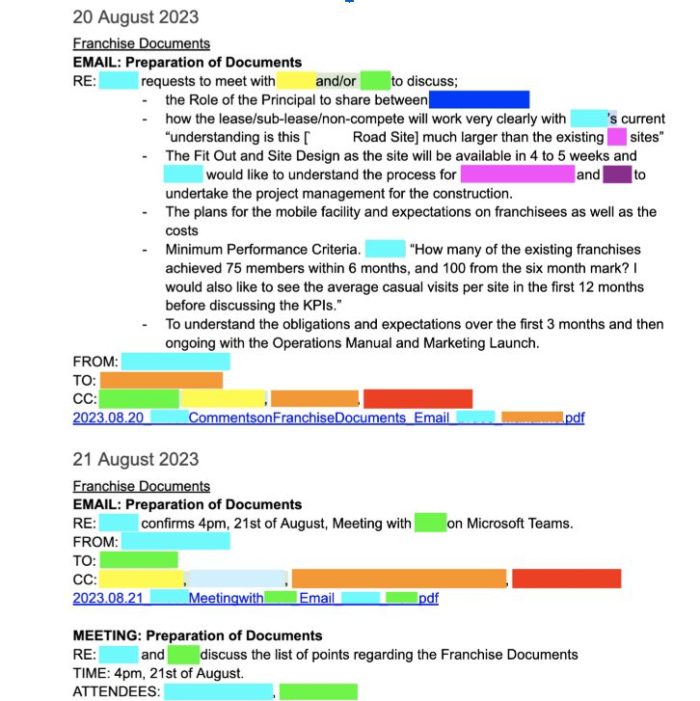
The Main issue was underlined. What it was (Email) and the Subject/Title sat below. Then the relevant information explained with names and businesses colour coded. Then who it was sent from, who it was to, who was cc’d and then a link to the document itself. This meant that if I was ever looking for something, It was super easy to search and I knew exactly how this document was relevant to the issue.
As you can see there, all my documents had set naming convention so it was easy to see what each document was at a glance. Each document was titled with the date, followed by a summary title, type of document and then the people involved.
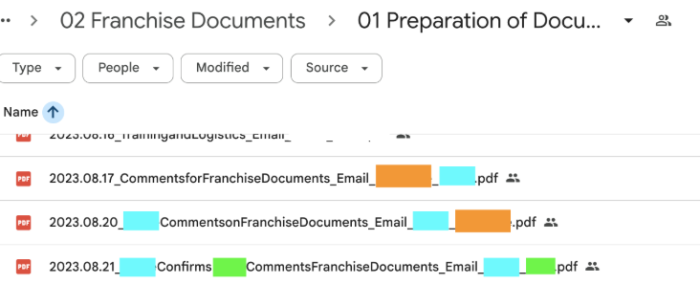
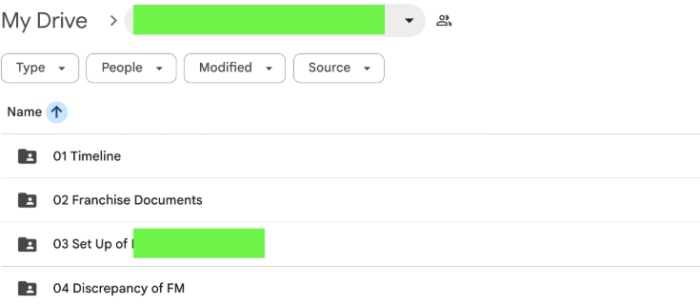
This was a long process, and what I wish I did at the sign of the first red flag, was start documenting it. Even if everything turned around, at least I could see all the decisions laid out in front of me, ensuring I was looking after myself and the business, while also trying to maintain a good working relationship with my franchisor and keep them accountable where necessary. It also saves you doing this at what is usually a very stressful time.
What do YOU want?
If it doesn’t turn around, it’s worth considering your options. Do you want to go through mediation? Issue a Breach Notice? Seek a buyback offer? The best way to determine the process is deciding what practical outcome you actually want. Some people want to terminate the contract so they can run their business without the higher-ups. Others want to get out and leave them to it. You can even take them to court to get reimbursed for the loss of time and money. All the options take time and resources, so you want to be sure.
It pays to be prepared for a big heart wrenching break up in franchising businesses. It gives you the space and time to have a cry on the couch, eat straight from the ice cream tub while watching sad movies. So, you can come to mediations and litigation with a less emotional, more pragmatic perspective that is backed up by easy to find evidence.

Zahli McFarlane
Before law school, Zahli spent two years in the trenches running a family-owned franchised wellness studio, so she's writing from experience. She's now a Paralegal at BDC Law and Juris Doctor student at Monash, with a passion for practical legal knowledge that actually helps people.