
Bathroom renovations offer something most residential building work does not: a repeatable scope. The same trades, a comparable sequence and a project size that fits inside a predictable schedule.
That repeatability is the commercial argument. It is also why the segment attracts both franchise buyers and independent operators, and why the two routes deserve honest comparison before anyone commits capital.
Long-term success turns on the parts that are invisible in a finished bathroom. Licensing, insurance, quoting discipline, documentation and waterproofing control all need to be settled before the first strip-out.
Key takeaways
Licence class is state-specific. There is no national bathroom renovation licence, and the thresholds that trigger insurance differ in every jurisdiction.
The trade licence question is the one most operators underestimate. A bathroom renovation typically requires building, plumbing and electrical work, and holding all three is rare.
Waterproofing is where the defect claims come from, so treat inspection points and cure time as fixed rather than compressible.
Franchise entry costs in this segment range from around A$35,000 to A$200,000 depending on the network and territory.
Quote by line item. A single lump sum makes variations difficult to price and disputes difficult to defend.
Operating independently gives you control over margins, branding and project scope. It also means building your own lead generation, estimating templates, supplier terms and operating procedures from nothing.
A franchise trades some of that control for an established name, training and systems. Published entry costs vary considerably.
Refresh Renovations lists a franchise fee of A$100,000 excluding GST and an estimated total investment of A$146,000 to A$200,000 excluding GST in Australia. Bathroom Werx states an initial investment of A$45,000 covering training, tools, starting stock, uniforms and vehicle signwriting. Megasealed lists franchises from A$35,000 plus GST per territory with training and ongoing support.
These figures come from franchisor materials and change. Treat them as starting points rather than budgets, and ask specifically about working capital, ongoing fees, territory restrictions, marketing contributions and exit conditions.
Proper franchise due diligence tests those assumptions rather than accepting them. In a trade-licensed segment there is an additional question most buyers miss: whether the network's model assumes you already hold the relevant licence, or whether it expects you to subcontract the regulated work.
The current Franchising Code
Australia's Franchising Code of Conduct commenced on 1 April 2025, replacing the previous code.
For agreements entered into, renewed or extended on or after 1 November 2025, franchisors must give franchisees a reasonable opportunity to make a return on their required investment. That is not a guarantee of profit. Those agreements must also address compensation for early termination in specified circumstances.
The ACCC publishes guidance for the model disclosure document and operates the Franchise Disclosure Register. Register processes and disclosure requirements change, so check current ACCC guidance during due diligence.
Read the disclosure document and the franchise agreement properly. Independent legal and accounting advice is the cheapest part of this process and the part most often skipped.
Licensing and insurance by state
Building and waterproofing requirements differ by jurisdiction. Confirm the licence class and insurance thresholds with the regulator in every state or territory where you intend to work.
New South Wales
Waterproofing is regulated as residential building work. An appropriate contractor licence is generally required once the total value of residential work exceeds A$5,000, including labour, materials and GST.
Home Building Compensation cover of at least A$340,000 is required for residential projects valued at A$20,000 or more. Cover must be in place before work begins or before payment is taken.
Victoria
Victoria offers a Domestic Builder registration class limited to bathroom, kitchen and laundry renovations, which suits a narrow scope. Operators intending broader work need an unlimited class instead, and the distinction matters when a bathroom job turns out to involve a structural change.
Domestic Building Insurance is required for residential building work worth more than A$16,000.
Queensland
Building work is licensed through the Queensland Building and Construction Commission, with restricted builder classes covering certain kitchen, bathroom and laundry work.
The Queensland Home Warranty Scheme applies to primary insurable work valued at more than A$3,300 when performed by a licensed contractor.
The three-trade problem
Here is the operational reality that licence tables do not capture.
A typical bathroom renovation involves building work, plumbing work and electrical work. Each is separately licensed. Most renovation businesses hold one of the three and subcontract the other two, which introduces coordination risk, margin leakage and a gap in accountability when something fails.
The alternative is holding all three, which is uncommon and worth understanding as a competitive position.
O'Shea Trades, a Melbourne firm operating since 1978, is one example. Its published licence details list DB-U 101491, 52736 and REC-36928, covering registered building, plumbing and electrical work under one entity. The company states this means one point of contact, one quote and no gaps between contractors.
Reviewing how bathroom renovations in Melbourne are scoped by a multi-licensed operator is useful for anyone building comparable documentation. The company publishes a defined inclusions list covering complete bathroom renovations, ensuites, powder rooms, shower upgrades, vanity and storage, toilet relocation, bath installation or removal, tapware, lighting and exhaust, waterproofing and tiling, plumbing and electrical, and layout changes.
It also publishes what it checks behind the walls, including water pressure, hot water temperature safety, sewer and waste connections, waterproofing requirements, ventilation and whether existing plumbing suits the new layout. That pre-works checklist is the part worth copying, because it converts a defect risk into a documented inspection.
The business reports serving more than 50,500 Melbourne homeowners across 48 years and holds a 4.9 rating across 3,621 reviews, with accreditations including the Housing Industry Association, Master Builders and Master Plumbers.
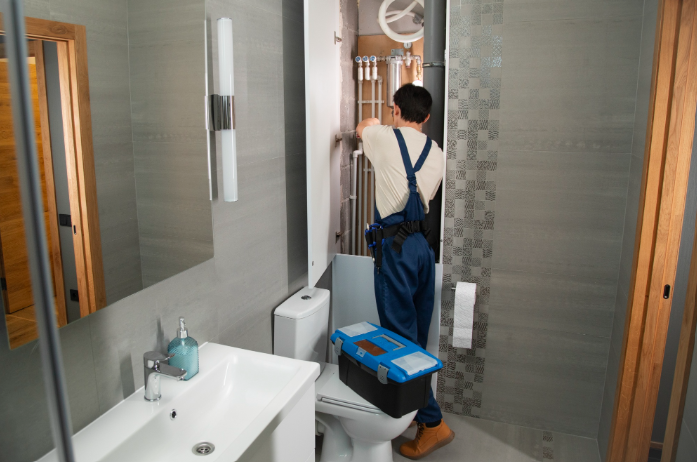
Waterproofing failures produce the costliest defects and the most difficult disputes in this segment.
Use the applicable version of AS 3740 for domestic wet areas, follow product instructions exactly and keep dated photographs of every stage. Photographs are the only practical defence when a claim arrives eighteen months later.
A workable sequence runs strip-out, plumbing and electrical rough-in, sheeting, screeding, waterproofing and curing, tiling, fit-off, then a documented quality check before handover.
Build inspection points and drying time into the schedule as fixed items. Treating cure time as a delay to be compressed is the single most common cause of the failures the standard exists to prevent.
Scope, quoting and timelines
Quote by line item rather than one unexplained figure. Separate demolition, waterproofing, tiling, fixtures and allowances so clients understand the price and can approve variations in writing.
Set timeline expectations early and in writing. Industry practitioners typically quote around six to ten weeks for a straightforward bathroom renovation, extending where scope, material lead times, layout changes or issues uncovered during works require it.
The ABS recorded A$3.7 billion in alterations and additions to residential buildings in the December quarter of 2025 on a seasonally adjusted basis. That covers the broader renovation market rather than bathrooms alone, but it frames the level of residential improvement activity.
A specialist scope is easier to price and schedule than general building work, which is precisely why the segment supports both franchise networks and independent specialists.
Building the operating foundation
Reliable relationships with licensed plumbers, electricians, tilers and suppliers determine whether you can hold a schedule. Local search visibility, genuine project galleries and clear written scopes generate better enquiries than discounting.
Before finalising your scope sheets, examine how established specialists present inclusions, exclusions, timelines and service boundaries. The gap between a professional scope document and an improvised one is visible to homeowners and shows up in conversion.
Your first 90 days
Register an ABN through the Australian Business Register and arrange the required tax registrations
Confirm your licence class with the regulator in each jurisdiction where you intend to trade
Arrange public liability, workers compensation where required and the relevant home warranty cover
Open supplier accounts and establish working relationships with licensed plumbers and electricians
Create quoting templates, a written variation form and a performance sheet tracking lead-to-quote rate, quote-to-win rate and gross margin
Build a photographic documentation protocol before the first job rather than after the first dispute
Frequently asked questions
Do licence requirements apply nationally?
No. Licence classes, registration and insurance obligations differ by state and territory. Confirm requirements with the relevant regulator before quoting in any jurisdiction.
Do I need building, plumbing and electrical licences?
A typical bathroom renovation involves all three types of work. You can hold one licence and engage licensed subcontractors for the others, which is the common model, or hold all three under one entity, which is rarer and removes the coordination gap.
When should home warranty cover be arranged?
Requirements vary by jurisdiction. In New South Wales, Home Building Compensation cover must be in place before work begins or before payment is taken. Victoria and Queensland apply different thresholds.
Does the Franchising Code guarantee profit?
No. The reasonable opportunity to make a return requirement introduced for agreements from 1 November 2025 is not a profit guarantee and is not a substitute for independent due diligence.
How long does a bathroom renovation take?
Around six to ten weeks for a straightforward project, longer where the layout changes, materials have long lead times or hidden issues emerge during strip-out. Give clients a written timeline before work starts rather than a verbal estimate.
How should variations be managed?
Set out the changed scope, the price and any scheduling effect in writing, then obtain written approval before carrying out the work. Verbal variations are the most common source of payment disputes in residential renovation.
The foundations are the same either way
Whether you buy a franchise or start independently, the compliance requirements do not change. Specialist operators and franchise networks work inside the same regulatory environment and face the same defect exposure.
What separates the businesses that last is unglamorous. Clear contracts, dated photographs, written approvals and disciplined variation records. Those records are what turn a disputed job into a resolved one.