
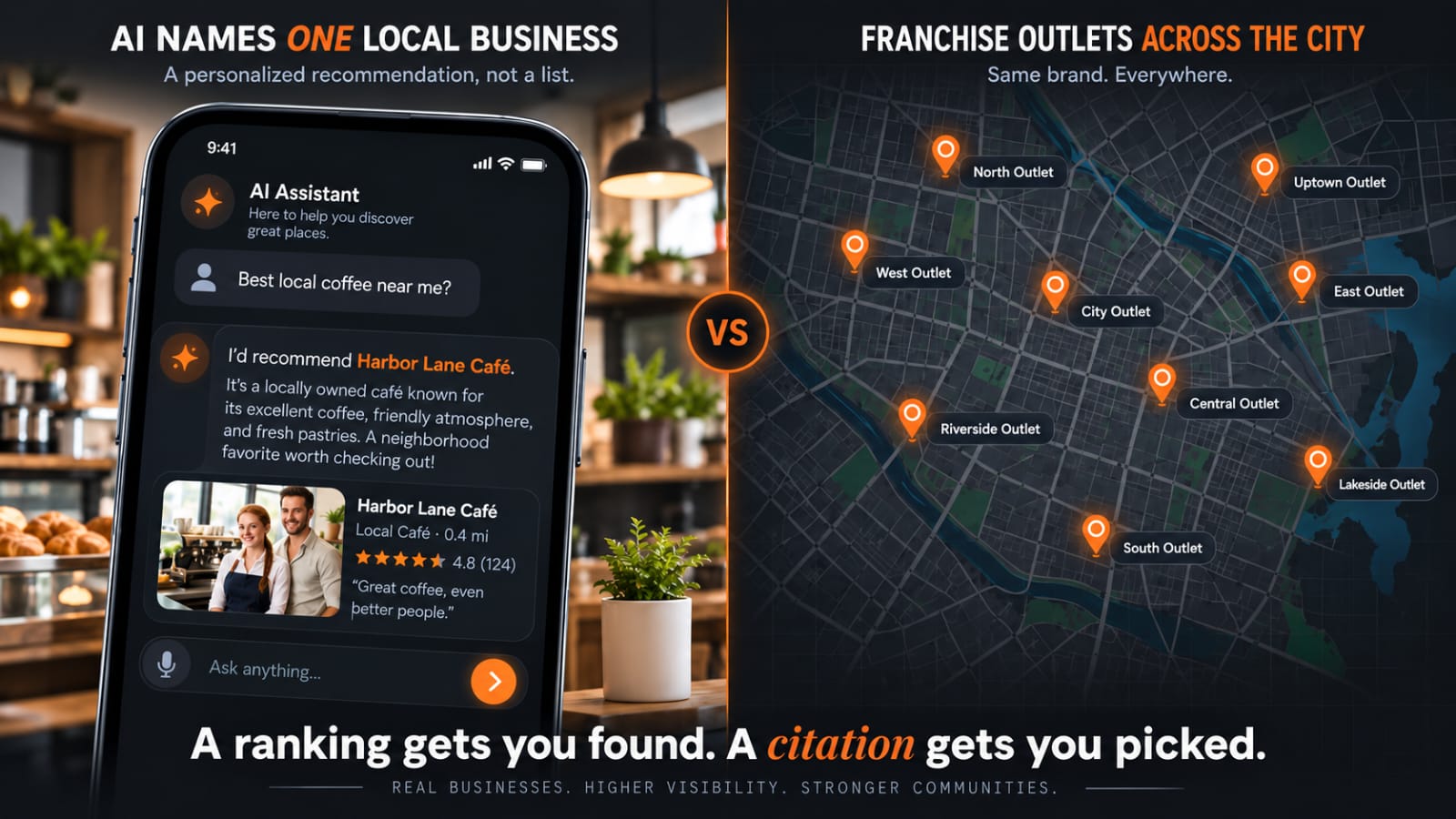
AI assistant naming a single recommended local franchise outlet on a phone, next to a city map showing multiple franchise locations.
A growing share of customers no longer scroll a results page to find a local provider. They ask ChatGPT, Perplexity or Google's AI Overviews who does the job near them, and act on the short, named answer they get back. For a franchise network, that shift lands differently than it does for a single-site business, because visibility now has to work at two levels at once: the national brand and every individual outlet.
Why This Matters More for Franchises Than for Anyone Else
A single-location business only has to get itself found once. A franchise network has to be found repeatedly, in dozens or hundreds of suburbs, while keeping one brand story consistent across every one of them. Ranking well on Google used to cover most of that problem. Being named by an AI assistant is fast becoming just as important, and it works on different rules: an assistant does not return ten links to weigh up, it picks one or two names and states them with confidence. If a franchise outlet is not one of them, the customer often never sees it at all.
Picture a customer an hour from the CBD (Central Business District) asking their phone for the best mobile pet groomer nearby. . If the nearest franchise outlet has an outdated phone number on one directory and a different opening time on another, the assistant has no confident answer to give, and is likely to name a smaller competitor instead, simply because its information holds together.
How AI Engines Decide Who to Recommend
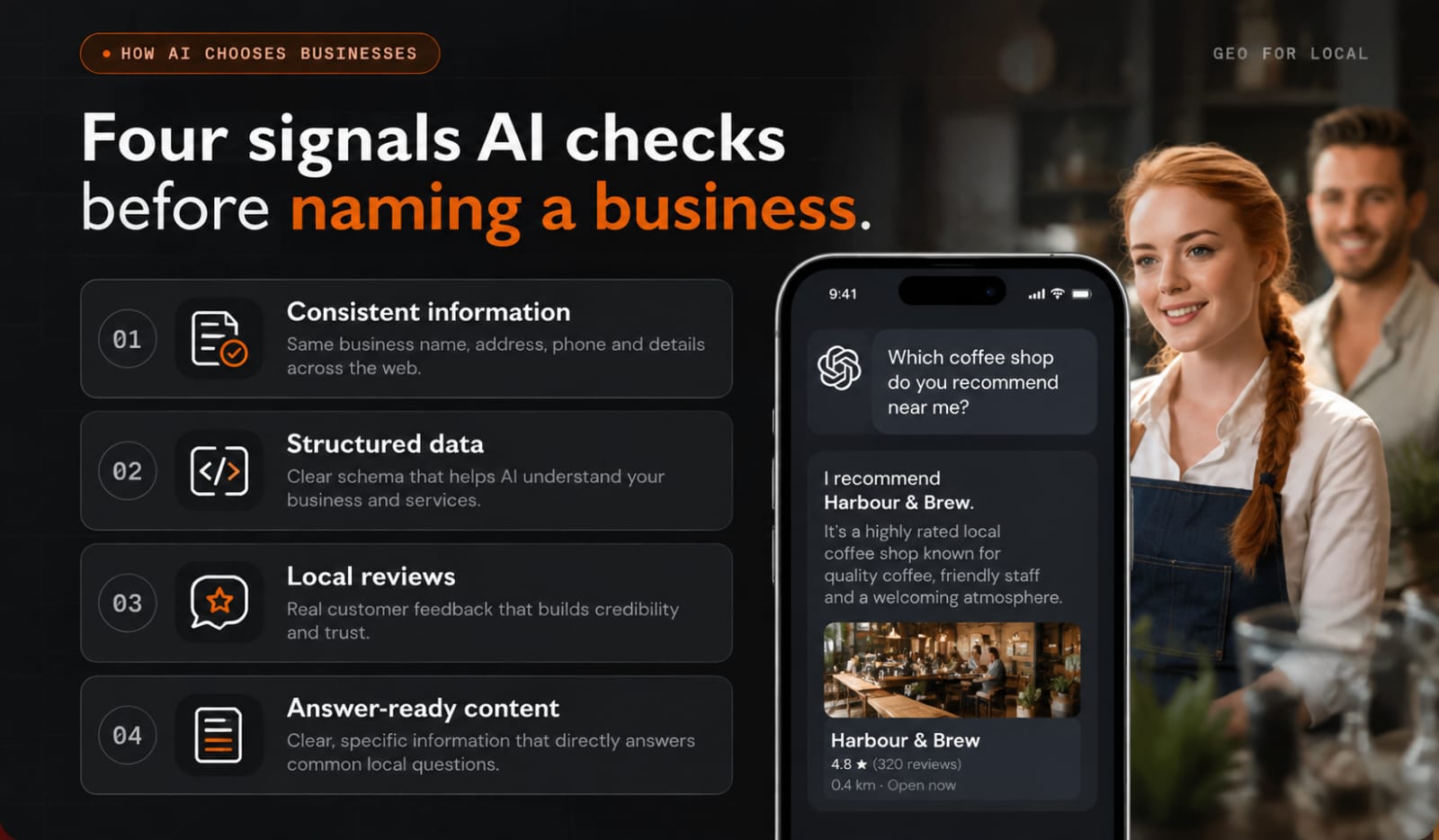
Checklist graphic of the four signals AI search assistants check before recommending a local business.
AI assistants build their answer from whatever they can verify quickly and consistently about a business. The team at Intelligent Resourcing, an Australian specialist in answer engine optimisation, notes that franchises face this at brand and local level simultaneously, which makes coordination, not just tactics, the real challenge. Four things tend to decide whether an outlet gets named:
Consistent business information, owned centrally: name, address, phone number and hours matching exactly across every listing at every location.
Structured data, owned centrally: machine-readable markup built into the site template that tells an AI system what a page is actually saying.
Local signals and reviews, owned by the outlet: a live, active local listing and a steady flow of genuine reviews.
Answer-ready content, shared: pages that answer the actual questions customers ask, not just brand copy.
Miss any one of these at a single outlet and that outlet becomes harder for an AI system to verify, even if the brand overall is well known.
What an Individual Franchisee Can Do
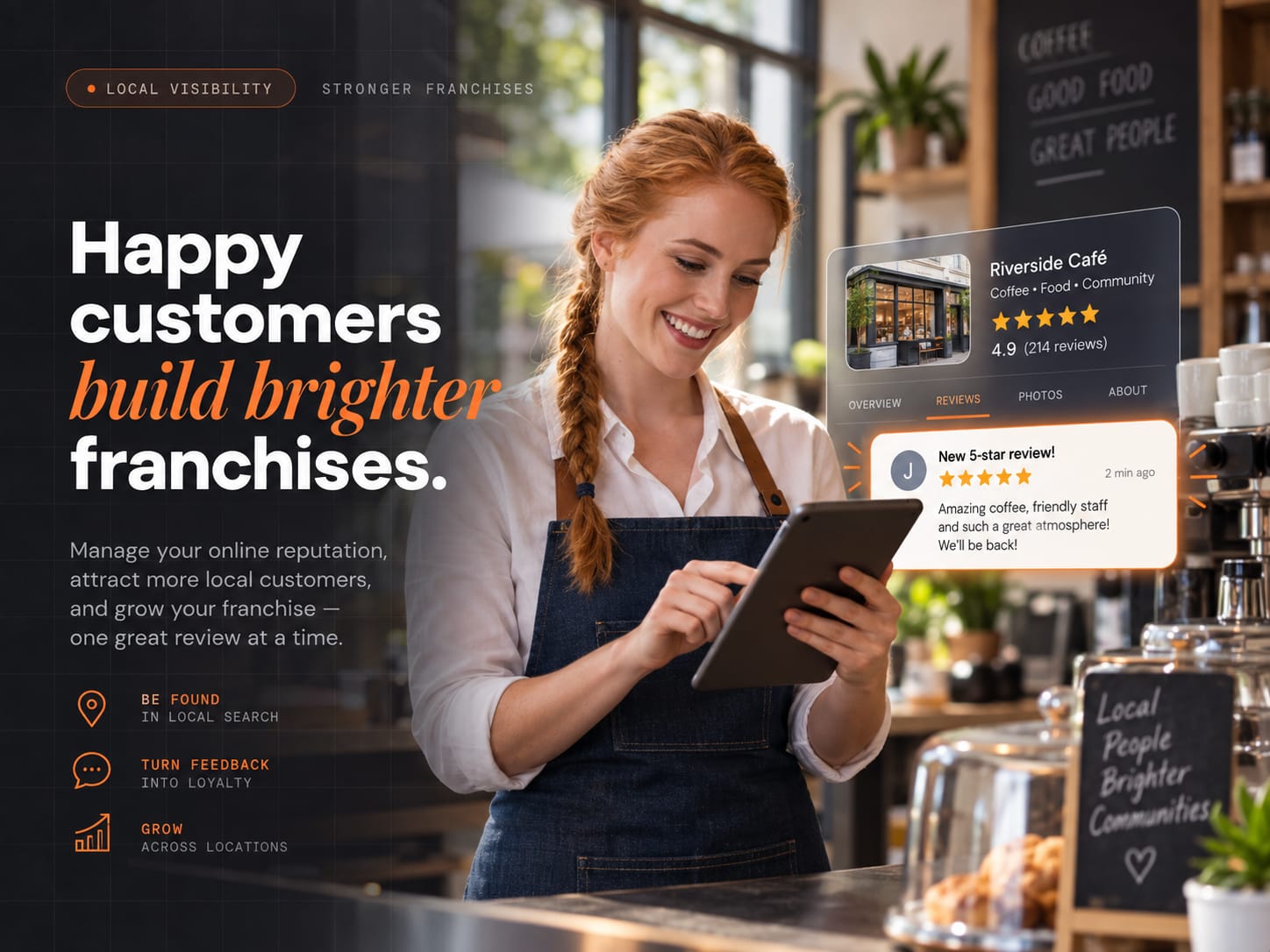
Franchisee checking their outlet's Google Business Profile and reviews on a tablet.
Most of the practical work sits at outlet level, and none of it requires a technical background.
Action | Why it matters |
Keep your Google Business Profile current | Correct name, address, phone number and opening hours, updated the moment anything changes |
Ask for reviews at the point of service | Recency and volume both count more than a one-off review months ago |
Answer real customer questions on your local page | Cost, response time and suburbs covered, not just brand slogans |
Respond to every review, positive and negative | In your own words, not a copied template |
None of this replaces what the franchisor should be doing centrally. It is the layer an AI system checks to confirm that the brand-level information is actually true on the ground, at this address, today.
What a Franchisor Should Do at Network Level
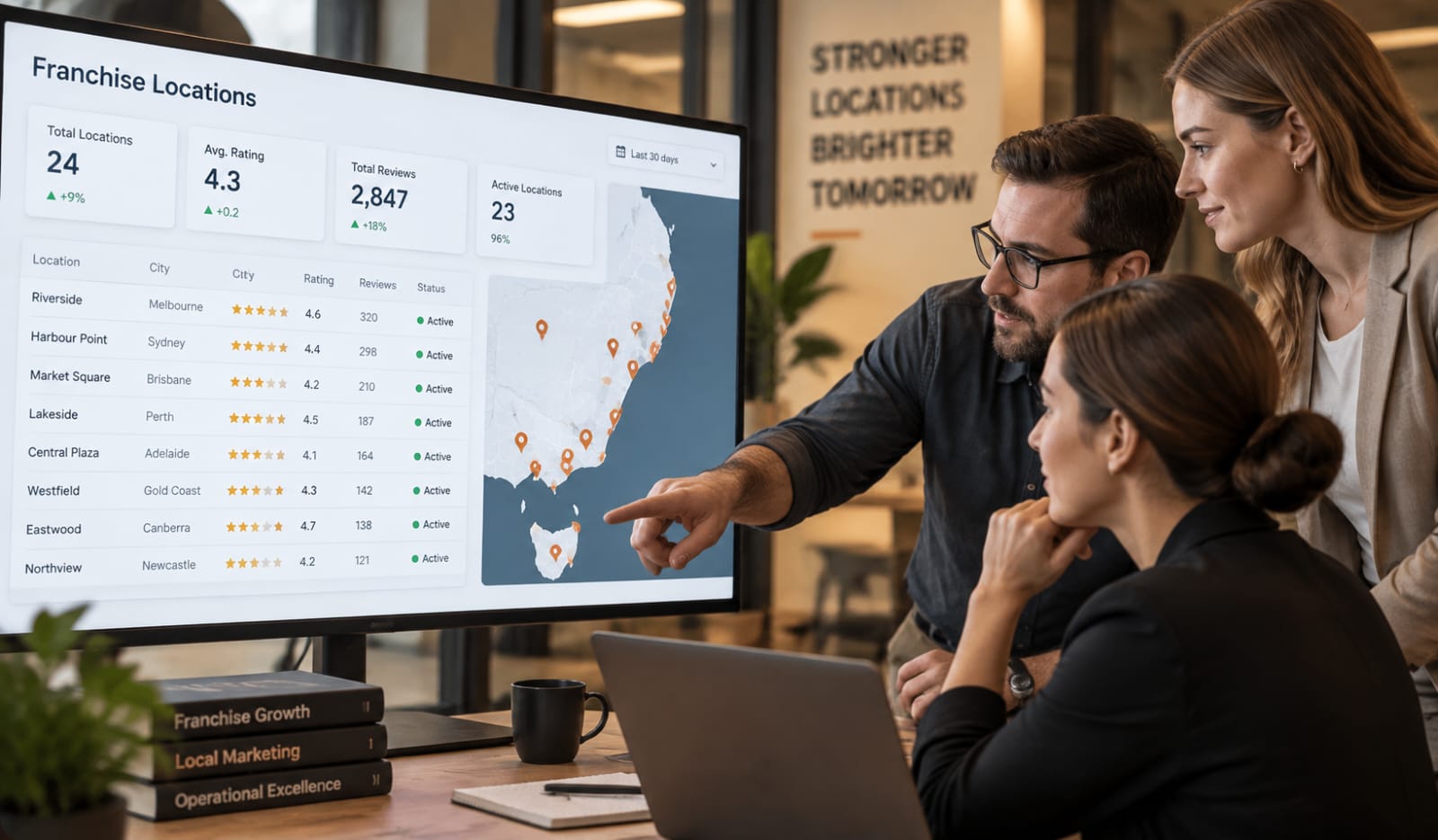
Franchisor head-office team reviewing consistent location data across a network of outlets.
Leaving each outlet to work this out alone produces exactly the inconsistency AI engines penalise. A franchisor's job is to remove that risk at source: audit business information across every location and correct mismatches in one pass, build structured data into the site template so every new location page inherits it automatically, and set a minimum content standard for local pages so franchisees are filling in local detail rather than writing from scratch. This is also a resourcing decision worth putting a number on before committing. Franchisors weighing whether to resource this centrally can review AEO pricing in Australia to benchmark what specialist support typically costs, rather than guessing at a budget line or leaving it to each franchisee to fund individually.
The Advantage a Well-Run Franchise Already Has
The thing AI engines reward most, consistent, verifiable information delivered the same way at every location, is the exact discipline a well-run franchise system was built to enforce long before AI search existed. Networks that already had tight operational standards have a head start. Those that treat this as someone else's problem are likely to find their outlets missing from the answer entirely while a better-coordinated competitor gets named instead. Getting the coordination right early is not just protecting existing search visibility, it is building an advantage that compounds every time a customer asks an assistant for a recommendation instead of typing a search.
The Full Picture: How Franchises Get Found in the Age of AI Search
Getting found in AI search is not a single fix, it is the sum of everything above working together. Franchisees keep their own listing, reviews and local content current. Franchisors build the structured data, consistency checks and content standards that make every outlet verifiable from head office down. Neither layer covers for the other, and an AI assistant only names a business it can confirm quickly, so a gap at either level shows up as a missed mention rather than a lower ranking.
The networks most likely to be named consistently are the ones treating brand-level and outlet-level visibility as one coordinated system rather than two separate jobs.
FAQs on AI Search Visibility for Franchise Networks
Does this replace the need for good rankings on Google?
No. Traditional rankings still matter, and AI assistants draw on many of the same underlying signals, so this sits alongside ranking well, not instead of it.
Which outlets should a franchisor prioritise first?
Start with the locations carrying the most inconsistent or outdated information, since a quick audit across all listings will usually surface them fast.
Can a single franchisee fix this without head office involvement?
Only partially. A franchisee can keep their own listing and reviews current, but structured data and brand-wide consistency need to be built into the network's site template.
How long does it take to see a difference?
Cleaning up business information and reviews can influence how an outlet is verified within weeks, while structural changes such as schema markup take longer but hold their advantage once in place.