

By Helen Kay, Franchise Lawyer, Rise Legal
Earlier this year I presented at the Franchising Expo on the topic “Buy a Franchise With Confidence.” After working with franchisees and franchisors for many years, I have found that many of the problems in franchising do not arise when the franchise starts, but when a franchisee wants to exit, sell the business, or move on. Very often, the difficulty is not caused by the franchisor or the system itself, but because the franchisee did not fully understand the agreement, the process, or the restrictions before they agreed to. It is often at that point that franchisees realise how important the franchise agreement and disclosure documents really were when they first signed them.
Buying a franchise is a significant legal and financial commitment. You are not just buying a business, you are buying into a brand, a system, and a long-term legal relationship governed by detailed legal documents and the Franchising Code of Conduct. Too often people get caught up in the excitement of starting a new business and rush the process without fully understanding what they are agreeing to. Doing your homework is the secret sauce to success.
This is also an important message for franchisors. Franchisees who obtain proper legal advice before signing usually understand the agreement better, have more realistic expectations and are less likely to end up in disputes. In my experience, the best franchisors encourage franchisees to obtain independent legal advice and often refer them to experienced franchise lawyers. Well-advised franchisees usually become better franchise partners and operate stronger businesses, which benefits the entire franchise network.
For franchisors, this article may also be useful to share with sales teams and prospective franchisees, as many of the issues discussed below are the most common mistakes people make when buying a franchise.
The Biggest Mistakes People Make When Buying a Franchise
- Not Understanding the Franchise Documents
One of the biggest issues I see in practice is not actually when people buy a franchise, but years later when they want to leave, sell the business or exit the system. This is often when new clients come to me for advice, and a very common issue is that they signed the franchise agreement years earlier without obtaining proper franchise legal advice and did not fully understand what was in the documents they received.
When buying a franchise, there are several important documents that franchisees receive, and each of them has a different purpose. It is important not just to receive these documents, but to understand what they are telling you and what questions you should be asking.
The Information Statement
The Information Statement should be given right at the start of discussions. It is designed to explain the risks of franchising and encourage prospective franchisees to do their research and seek professional advice. This document must be provided early in the process, as soon as practicable after a person expresses interest in the franchise and before any other franchise documents are provided.
Many people treat this document as just another piece of paperwork, but it is actually a very important document because it tells you exactly what you should be doing before you commit to a franchise. It encourages franchisees to do their due diligence, speak to other franchisees, and obtain legal, accounting and business advice. My advice is that franchisees should take this document seriously, because it is effectively a warning document that explains the risks of franchising.
The Disclosure Document
The Disclosure Document is a very important document because it contains key information about the franchise system. This includes details of legal proceedings, contact details for current and former franchisees, the costs involved in operating the franchised business and what happens when the franchise agreement comes to an end. This document must be provided at least 14 days before the franchisee enters into the franchise agreement or makes a non-refundable payment.
Franchisees should not just file this document away. They should read it carefully and use it as a due diligence tool. It provides contact details for current and former franchisees, and one of the best things a prospective franchisee can do is actually call those people and ask about their experience. The Disclosure Document should also be analysed with financial advisers to understand all the costs involved in operating the business, not just the franchise fee.
The Franchise Agreement
The Franchise Agreement is the main legal document that sets out each party’s rights and responsibilities. This agreement will govern the relationship for five years or more, so it is very important that franchisees understand their obligations, fees, restrictions and what happens if they want to sell the business or if the agreement comes to an end.
Many of the issues that arise later, particularly when a franchisee wants to exit, are usually dealt with in the franchise agreement. This includes things like transfer conditions, restraint clauses, renewal rights and termination provisions. This is why it is so important that franchisees understand this document before signing, because once the agreement is signed, those terms will apply for the entire term of the franchise.
- Not Understanding the Timing and the Process
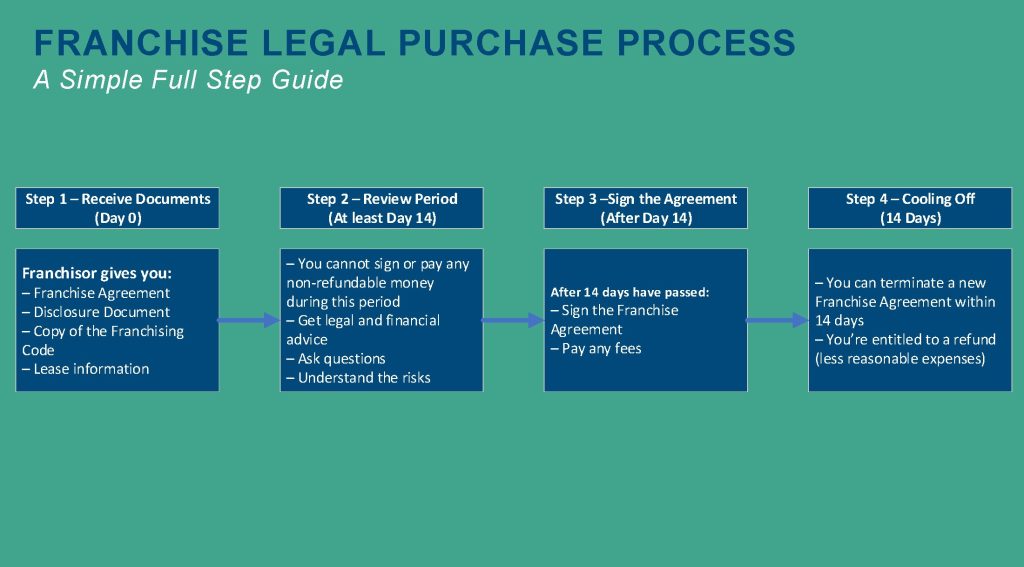
One area that often causes confusion when buying a franchise is the timing involved in the process. In particular, many franchisees are led to believe that they must sign the franchise agreement as soon as the 14 day disclosure period has passed. This is not correct.
Under the Franchising Code of Conduct, the franchisor must provide the Disclosure Document, the Franchise Agreement and the Code at least 14 days before the franchisee enters into the agreement or makes a non-refundable payment. This 14 day period is a minimum period, not a deadline. Franchisees do not have to sign on the 15th day. The purpose of this period is to give franchisees time to review the documents properly, obtain legal and financial advice and carry out their due diligence.
There is also a separate 14 day cooling-off period which starts after the franchise agreement is signed. During this period, a franchisee can terminate the agreement, although the franchisor may retain reasonable expenses if those expenses were disclosed in writing before signing. The cooling-off period is a protection for franchisees, but it should not be relied on as a safety net. The documents should be properly reviewed and understood before signing the agreement.
Franchisees should take the time to understand the business, review the documents, obtain expert advice, confirm their business structure and finance, and make sure they are comfortable with the agreement before signing. If a franchisee feels pressured to sign quickly, that is usually a sign that they should slow down and obtain advice before proceeding.
- Not structuring the purchase correctly
One of the most common mistakes I see is franchisees starting the business with the wrong structure. Many people initially think about operating as a sole trader because it seems simple, but this can expose them to significant personal risk.
As a sole trader, you are personally liable for all business debts and obligations, including obligations to the franchisor, staff, landlords, customers and suppliers. In many cases, operating through a company structure can help limit personal liability and protect personal assets. This is something that should be considered early in the process, not after the documents have already been signed.
Another issue that is often overlooked is who should actually be included in the company structure. Franchisees should think carefully about who is listed with ASIC as a director or shareholder. Usually, only the people who are genuinely involved in the business and understand the risks should be included, because those people are often also required to provide personal guarantees under the franchise agreement and, in many cases, under the lease as well. Many people do not realise that being named as a director or shareholder may carry real personal risk.
Structuring the purchase correctly from the beginning is important not only for liability reasons, but also for ownership, tax, succession planning and what happens if the business is sold in the future. It is something that should be discussed with both an accountant and an experienced franchise lawyer before any documents are signed.
- Not doing enough (or any) due diligence
Another common mistake is not doing enough due diligence before committing to a franchise. Buying a franchise should involve proper investigation into the business and the franchise system, not just reading the marketing material or relying on what you are told during the sales process.
Due diligence means taking the time to properly investigate the franchise system and ask the right questions. One of the most important things a prospective franchisee can do is speak with existing franchisees and, if possible, former franchisees. They can provide valuable insight into what it is really like to operate the business, the level of support provided by the franchisor, the actual costs involved in running the business and whether the business met their expectations.
The Disclosure Document is also an important due diligence tool, not just a legal document. It contains contact details for current and former franchisees, information about legal proceedings, and details of costs and fees. This document should be used as part of your investigation into the franchise system, not simply kept on file because it was provided.
Prospective franchisees should also be asking practical questions of their franchisor and lawyer about the business itself, such as what training and support they will receive, what the minimum performance requirements are, what ongoing costs are involved, and what happens if they want to sell the business in the future. These are practical business questions, but they often have legal and financial consequences later.
Doing proper due diligence takes time, but it is one of the most important parts of buying a franchise. The more a franchisee understands the business and the system before signing, the fewer surprises there will be later.
- Not Engaging Experienced Franchise Experts
One of the key messages I shared at the Franchise Expo is that franchising is a specialised area. Not all lawyers, accountants or advisers understand franchising and the Franchising Code of Conduct. It is important that franchisees obtain advice from people who understand franchise agreements, disclosure documents and the franchise buying process.
This is also an important message for franchisors. Franchisees who obtain proper legal advice from experienced franchise lawyers before signing tend to understand the agreement better, have more realistic expectations and are less likely to end up in disputes. In my experience, the best franchisors encourage franchisees to obtain independent legal advice and often refer them to experienced franchise lawyers like us. Well-advised franchisees usually become better franchise partners and operate stronger businesses, which benefits the entire franchise network.
Final Thoughts
Buying a franchise is an exciting opportunity, but it is also a long-term legal and financial commitment. Many of the issues that arise later, particularly when a franchisee wants to sell or exit the business, can usually be traced back to decisions made and documents signed at the very beginning.
Taking the time at the start to properly understand the franchise documents, the process, the structure and the business itself can make a significant difference to how successful and how smooth the franchise journey will be. Too often, people focus on getting into the business quickly without spending enough time understanding the relationship they are entering into.
Franchising works best when franchisees start the relationship well informed and well advised, and when franchisors encourage franchisees to obtain independent advice before signing. In my experience, franchisees who understand the documents and the system from the beginning are far more confident, have more realistic expectations and are better equipped to build successful businesses within the franchise network.

Helen Kay, is an accomplished business and franchise lawyer with over two decades of legal expertise. As the founder of Rise Legal, Helen specialises in delivering strategic and practical commercial and franchise legal solutions. Her exciting career has seen her in pivotal roles at prestigious law firms, consistently offering exceptional legal counsel. Her unique combination of hands-on experience and visionary leadership positions her as an invaluable asset in the realm of commercial law and franchise expertise, assisting small and medium sized franchisors and franchisees in safeguarding their business through comprehensive commercial legal support.
Rise Legal Gold Coast | Perth | Sydney
T: 1300 064 707 | E: [email protected] | https://riselegal.com.au
Disclaimer: This article is intended for informational purposes only and should not be considered legal advice. Consult with a qualified commercial lawyer for personalised advice related to your specific circumstances.
Individual liability limited by a scheme approved under Professional Standards Legislation.